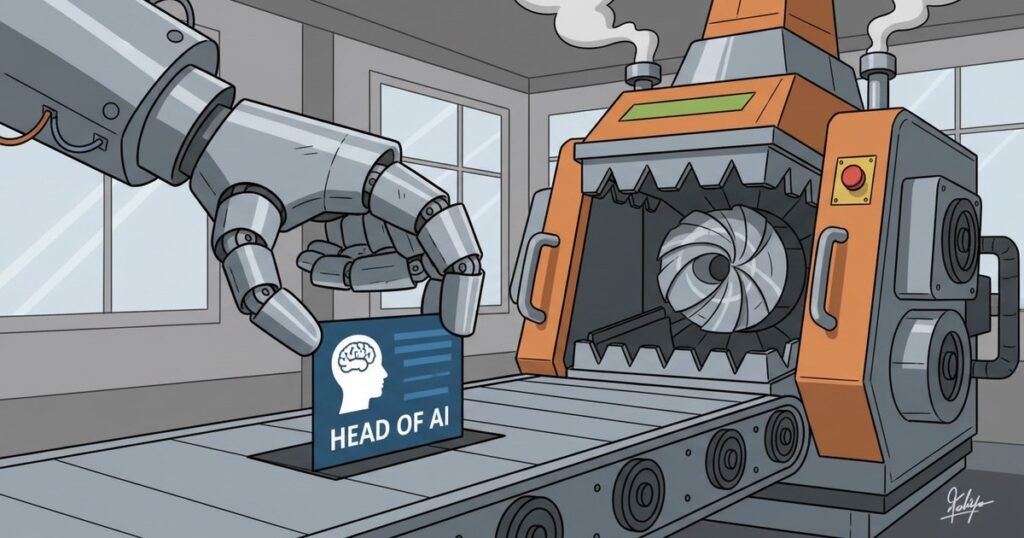

A European industrial conglomerate — the kind with metal-cutting divisions, global factories, and an IT org chart that looks like a family tree — just posted a role: Head of AI, Machining. Director-level. Remote, nominally, though you'll apparently be near a World Trade Center in a Nordic capital. The job is to "turn AI potential into measurable business results" across machining. Which is a lovely way of saying: we have forty pilot projects, none of which went anywhere, and we need someone to herd them.
That someone is not going to be a person for long.
What the role actually does
Strip away the leadership verbiage and here's the job: a large industrial company has dozens of machining operations — CNC programs, tool wear data, vibration signatures, scrap rates, cycle times — and a pile of AI initiatives that range from "predictive maintenance on spindle bearings" to "a chatbot that answers maintenance queries." None of these are connected. Each division did its own proof of concept with its own vendor, its own cloud tenant, its own definition of "model in production." The Head of AI is the human integration layer. They coach division leads on what's real, connect business pain to plausible technology, navigate cybersecurity and legal, and — the core skill — build alignment across people who have never agreed on anything.
That's a lot of words for: the role is a router. A very well-paid router sitting between business problems and technology solutions, with stakeholder management as the routing protocol.
How AI eats this role
The replacement isn't one model. It's a pipeline, and it maps almost exactly to the JD's bullet points.
Identify and prioritize AI initiatives. Feed the agentic system the division's operational data — ERP logs, MES outputs, maintenance records, OEE dashboards — and let it enumerate candidate use cases. A tool-calling LLM with access to a data catalog and a library of industrial-AI patterns (anomaly detection on sensor streams, computer vision for part inspection, RL for feed-rate optimization) can produce a ranked initiative list faster than any director. The ranking function is where you'd spend real effort: each candidate scored by estimated value (scrap reduction × throughput × margin), feasibility (data readiness, integration complexity), and risk. That's a spreadsheet with teeth. The AI fills the spreadsheet.
Develop business cases. This is where LLMs already shine. Give the model the candidate, the estimated impact range, the cost of implementation, and the relevant benchmark from publicly available case studies, and it generates a business case document in the house template. The financial modeling — NPV, payback period, sensitivity analysis — is deterministic code the LLM calls as a tool. The prose is the LLM. The result is a business case that a human would take a week to write, produced in minutes, and it's better than 80% of what consultants charge six figures for.
Connect business needs with technology. This is the "router" function, and it's the most automatable part. The system maintains a knowledge graph of the company's technology landscape — platforms, architectures, data pipelines, vendor capabilities, in-house skills — and maps each business problem to a recommended solution stack. "Reduce scrap rate on the five-axis milling line" → "ingest CNC program parameters and in-process measurement data → feature engineering on tool path and cutting forces → gradient-boosted classifier for scrap prediction → integrate with MES for real-time alerts → dashboard in existing BI tool." That recommendation, with architecture diagram and implementation plan, is the LLM's draft, reviewed by a deterministic validation layer that checks the architecture against the company's reference patterns and security requirements.
Guide opportunities through implementation. Here's where it gets fun. The agentic system doesn't just plan — it orchestrates. It drafts the data pipeline code, generates the integration specs, writes the test cases, and produces the deployment runbook. For a machining operation, the implementation is remarkably standardized: pull data from the CNC controller via OPC-UA or MTConnect, stream it through a processing pipeline, run inference, push results to the MES or a dashboard. The variation is in the parameters, not the architecture. An agent with access to the company's code repositories and deployment infrastructure can generate 70% of the implementation artifacts. The remaining 30% — physical integration, commissioning, validation on the actual machine — still needs hands. But those hands are not the Head of AI's.
Coach divisions and build alignment. This is the one that sounds un-automatable, and it's the one that's most quietly doomed. The coaching is 80% pattern-matching: division X has problem Y, the playbook is Z, here are three examples of similar companies that did it, here's the slide deck template, here's the talking points for the plant manager who thinks AI is a fad. An LLM with a good prompt library and access to the company's internal communication patterns generates the coaching content. The "alignment" part — getting people to agree — is political, and it's where the human remains. But even here, the system can draft the stakeholder map, identify the blockers, suggest the influence strategy, and write the emails. The human just sends them and nods in the meetings.
The pipeline, concretely
Here's what replaces the Head of AI, Machining at a company like this:
- A data catalog agent that continuously scans the company's data estate and maintains a live inventory of available data, quality, and access patterns.
- A use-case generation agent that enumerates candidate AI applications, scores them, and maintains a prioritized backlog.
- A business case agent that produces investment-ready documents with financial models.
- An architecture agent that maps problems to solution stacks, checks them against reference architectures and security/legal constraints, and produces implementation specs.
- A delivery agent that generates pipeline code, tests, and deployment artifacts, and coordinates with the (human) engineering teams who handle physical integration.
- A stakeholder agent that drafts communications, tracks alignment, and flags risks.
Six agents, a knowledge graph, a tool library, and a human in the loop for the 15% of decisions that require actual judgment — the ones where the "right" answer depends on organizational politics the system can't see, or where the business case hinges on a strategic bet the data doesn't capture.
Where it breaks
The honest part. The system above can't walk onto a factory floor, look at a machinist's face when the new "AI-powered" dashboard tells them their scrap rate is 4% above target, and understand that the dashboard will be ignored because the machinist has twenty years of experience the model doesn't respect. It can't sit in a steering committee and read the room when the division head who controls 40% of R&D budget is skeptical and needs to be made to feel like this was his idea. It can't negotiate with a vendor who's been in the account for fifteen years and knows the CTO personally.
The system also can't take responsibility. When a predictive maintenance model misses a spindle failure and a machine goes down, costing the company real money, the system doesn't get fired. A human does. That's the real reason the Head of AI exists: not to do the work, but to be the person who signed off on the work. The role is liability absorption. And that part — the part where a human puts their name on a decision and accepts the consequences — is the part that's hardest to automate, not because the technology can't, but because the org chart demands it.
There's also the data problem. A lot of machining data is garbage. Sensors that were never calibrated, CNC programs that were modified on the floor and never documented, maintenance logs that say "fixed" with no detail. The system can detect the garbage — that's a solved problem — but the decision to invest two million in data quality before you can do any AI is a judgment call that requires someone who understands the business and the politics. The system recommends. A human decides.
The verdict
The Head of AI, Machining is a role built for a transition period — the gap between "AI is a pilot" and "AI is just how we work." That gap is closing. The person who takes this job will spend two years building the playbook, and the playbook will be the thing that makes the next person unnecessary. The job posting is a company asking someone to write their own replacement, and paying director-level compensation for the privilege.
If you're the hiring manager reading this: build the pipeline, hire a lean team to run it, and skip the director. If you're the candidate: take the job, it's fascinating work, it pays well, and it's the best seat in the house for watching your own profession get automated. Just don't plan on the title existing in five years. The machines will be machining, and the Head of AI will be a server rack with an org chart entry.