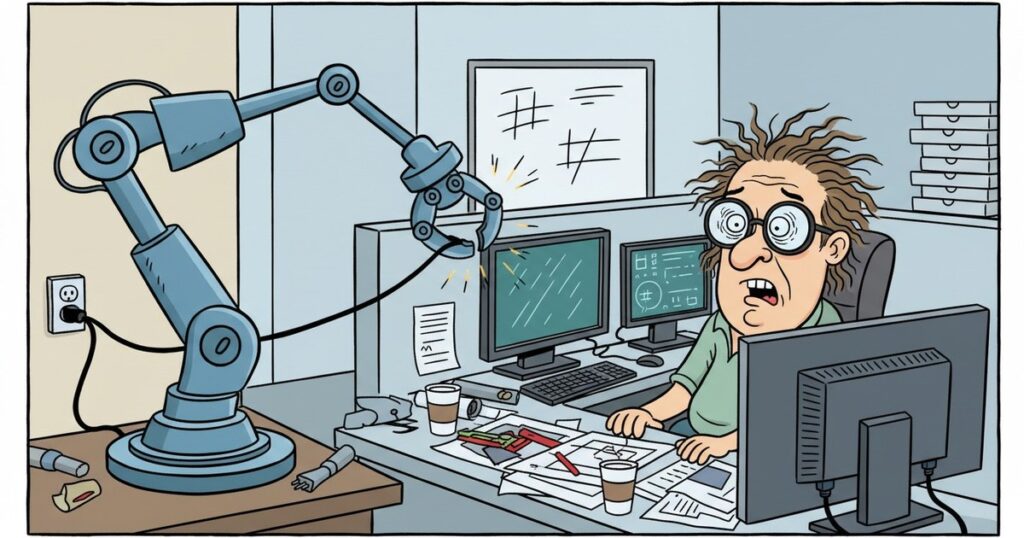

A fast-growing digital health company — remote, spread across a dozen-plus nationalities, saving millions of lives in theory — just posted for a Staff AI/ML Engineer. The pitch is the usual cocktail: take technical ownership end-to-end, lead from idea to implementation, challenge existing decisions constructively. Come build the machine that makes this company need fewer people. Including, eventually, you.
The role is a fascinating artifact of the current moment. A digital health platform has data pipelines, clinical workflows, and user-facing features. They need someone to come in and figure out where large language models, classic ML, and generative AI fit into all of that. They are hiring a person whose entire job is to figure out how to replace human effort with models. And they are hiring that person at a level that implies deep experience, architectural vision, and cross-functional leadership.
So let's take the prompt at face value. Here is how an AI system takes over the role of a Staff AI/ML Engineer at a fast-growing digital health company.
Phase 1: The Audit and the Roadmap
The first mandate in the job description is to audit the current AI setup and help define the AI strategy and roadmap. This is traditionally a six-week exercise of interviews, data cataloging, pipeline mapping, and a slide deck with a 12-month timeline.
An AI agent does this in an afternoon.
You give a code-interpreter-equipped LLM read access to the company's GitHub organization, their AWS or GCP project, and their dbt or feature store. The agent maps the repositories, identifies anything that imports transformers, torch, sklearn, or makes calls to an LLM API, and generates a dependency graph. It reads the Airflow DAGs to understand the data pipelines. It catalogs the models currently in production, their serving endpoints, and their observability dashboards.
The output is a perfectly structured markdown document detailing the technical debt, the architectural bottlenecks, and the immediate opportunities for LLM insertion. The roadmap is just a prioritized list generated by asking the model to weigh implementation effort, inferred from codebase complexity, against business impact, inferred from the frequency of user-facing feature requests in Jira. It is a slide deck generated instantly. The human Staff Engineer used to charge a premium for this exact deliverable.
Phase 2: System Design and Greenfield Architecture
The JD demands strong system design and architecture skills for greenfield projects. This is the core of the Staff IC role: sitting in front of a whiteboard and deciding whether to use a fine-tuned open-source model, a RAG pipeline over a vector database, or a multi-agent framework.
Today, architectural design for AI systems is rapidly becoming a constrained optimization problem that an LLM solves better than a human. You prompt a capable model with the constraints: We have patient intake forms in five languages, we need to extract symptoms and triage them, latency must be under two seconds, and we cannot send raw data to third-party APIs.
The AI does not need to deliberate. It will immediately output the architecture: a local deployment of a quantized 8-billion parameter model for PII redaction, followed by a routing layer to a fine-tuned classification head for triage, backed by a Redis cache for common symptom clusters. It will generate the Terraform scripts to provision the GPU instances, the Dockerfiles for the serving containers, and the CI/CD pipelines to deploy it.
The human Staff AI Engineer used to draw the boxes and arrows, debate the trade-offs of LangChain versus LlamaIndex in a Slack channel for three days, and then hand it off to a junior engineer to write the boilerplate. The AI now writes the boilerplate, the infrastructure, and the architecture. It even writes the trade-off document, arguing with itself about the merits of different vector databases.
Phase 3: Pipeline Maintenance and Observability
The JD explicitly states: evaluate, monitor, and maintain AI/ML pipelines in production. Not only build AI/ML solutions, but also assess their performance and keep them reliable over time.
This is the graveyard of human enthusiasm. No Staff ML Engineer wakes up excited to debug a feature pipeline that broke because a clinical database changed a column name from patient_dob to birth_date. It is necessary, vital work, and it is the definition of toil.
This is exactly what automated AI incident response is built for. An observability agent monitors the model serving metrics—latency, error rates, token usage, and drift in input distributions. When a pipeline breaks, the agent catches the anomaly, ingests the stack trace, pulls the relevant schema migration history from the database, identifies the root cause, writes a data transformation patch to map the new schema to the old one, and opens a pull request. The entire cycle, from pipeline failure to patched PR, takes four minutes. The human Staff Engineer reviews the PR, clicks Approve, and goes back to pretending they are indispensable.
The Catch: Where the Human Clings On
Here is the honesty section. It is not all automated. The JD asks for someone to challenge existing technical decisions constructively and stay focused on the product and the result. This is where the AI hits a wall.
An LLM can audit a codebase, but it cannot audit a company's politics. When the Head of Product insists on building a bespoke clinical-trial matching agent instead of simply integrating an off-the-shelf API, the AI does not know that the Head of Product is trying to justify their team's headcount for the next quarter. The AI does not understand that the CTO has a philosophical aversion to fine-tuning because they got burned by a hallucination at their last startup.
The AI can design the architecture, but it cannot navigate the organizational resistance to that architecture. It cannot sit in a room with the legal team and patiently explain, over the course of six meetings, why a deterministic regex layer in front of the LLM satisfies the regulatory requirements for clinical data processing. It cannot look a stressed-out engineering manager in the eye and convince them that ripping out the existing RAG pipeline and replacing it with a graph-based retrieval system is worth the two weeks of downtime.
In a digital health company, the data is messy, deeply contextual, and tied to human suffering. An LLM can ingest a million medical records, but it cannot sit with a clinician and understand the nuanced difference between a missed symptom and a symptom the patient forgot to mention. The human Staff Engineer is still needed to translate the messy, political, deeply human reality of the company into the rigid, formal constraints that the AI requires to build the system.
The Verdict
The digital health company posted a job for a Staff AI/ML Engineer. They want someone to come in and automate their AI strategy. They are hiring a human to build the machine that will make the human obsolete.
The irony is thick enough to cut with a scalpel. The role will exist for maybe another two years. During that time, the human will spend 20% of their time doing actual engineering—designing the constraints, navigating the politics—and 80% of their time reviewing the output of the AI agents that are doing the actual work. They will be a highly paid project manager for a team of synthetic engineers.
As we've seen across the software development lifecycle, AI is no longer just a coder; it is covering entire roles end-to-end. The Staff AI Engineer is just the latest casualty of their own success. They are building the scaffolding for the AI that will replace them.
Go ahead. Apply for the job. Build the pipeline. Train the model. Optimize the infrastructure. And when the system is running smoothly, and the tickets are closing themselves, and the pipelines are self-healing, ask your manager what the next project is. Just do not be surprised when the answer is: "We do not need a next project. We just need you to train your replacement."