
A European telecom infrastructure company is hiring a Developer Advocate. Read the posting carefully and you'll notice something: every single responsibility is a translation task. Translate developer confusion into engineering tickets. Translate engineering capabilities into documentation. Translate recurring friction into product improvements. That is, quite literally, what a language model does.
What the role actually does
Strip away the community-building romance and a Developer Advocate at a telecom platform company does four things:
- Answers questions in a developer community — the same dozen questions, rephrased, forever.
- Reproduces issues by spinning up the same environment, running the same integration steps, and capturing logs.
- Writes content — docs, examples, troubleshooting guides, demos — based on what broke and how.
- Routes things to the right engineering team with enough evidence that they can't ignore it.
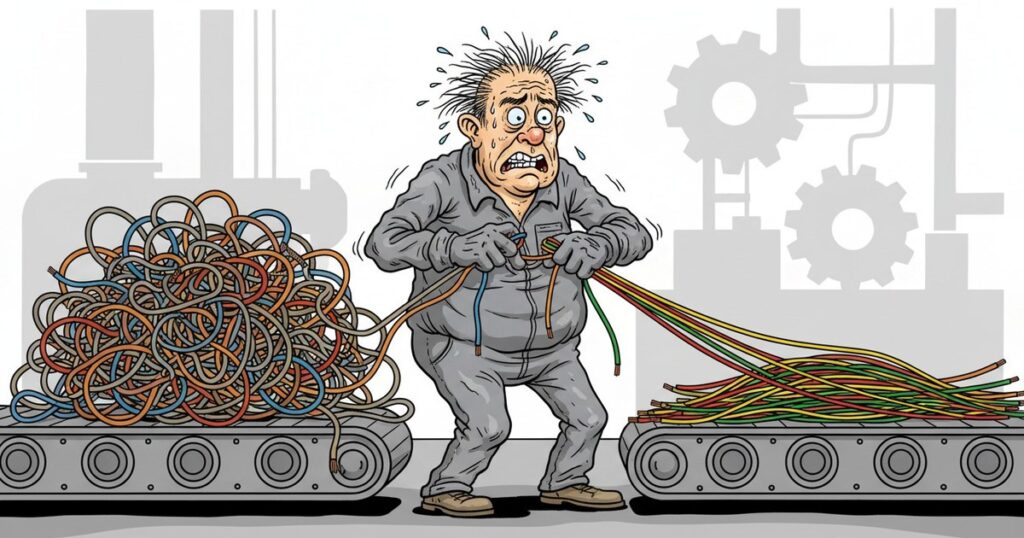
It is a relay station. Information comes in confused, gets cleaned up, and gets sent somewhere useful. The Advocate is a switchboard with empathy.
How AI takes the whole role
The pipeline is not hypothetical. You could build it in a quarter.
The community front desk. A retrieval-augmented chat agent ingests every message in the developer community, the entire SDK documentation, every resolved ticket, and every FAQ ever written. When a developer posts a question, the agent responds in seconds with a cited, grounded answer — pulling from the actual docs and prior solutions. If the question is genuinely novel, it flags it. The Advocate's "engage directly with developers" bullet is now a WebSocket.
The reproduction rig. The job asks for logs, environment details, timestamps, and reproduction steps. An automated reproduction harness can do this better than a human: containerize the developer's reported configuration, run the integration against a sandboxed instance of the intelligent controller, capture full telemetry, and diff against a known-good baseline. A human takes an hour to reproduce a finicky integration bug. A harness takes ninety seconds and attaches the logs automatically.
The evidence packager. Once the harness reproduces the issue, a second model writes the bug report: the reproduction steps, the environment, the logs, the stack trace, the suspected component, and a severity guess based on blast radius. It files it in the engineering tracker and tags the owning team. This is the "engage the appropriate specialist engineering team" bullet, done without a human reading anything.
The content engine. Every resolved issue becomes a documentation draft. The model takes the original question, the reproduction steps, the fix, and the engineer's explanation, and generates a troubleshooting guide entry, an FAQ update, and a code example. A human reviews — for now. The "create and improve developer documentation" bullet is a background job.
The friction analyzer. Feed every community message, support ticket, and abandoned integration attempt into a classifier. Cluster by failure mode. The model surfaces "fourteen developers hit the same auth timeout this week" as a single root-cause candidate. This is the "identify recurring developer friction" bullet — and a model is better at pattern detection across thousands of interactions than a human who remembers the loud three.
The part that sounds hard but isn't
You might think the hard part is the human touch — the empathy, the encouragement, the "understanding the intent and context behind their questions." It is not. Developers don't want warmth from an Advocate. They want their integration to work. They want the answer fast, accurate, and copy-pasteable. A model that responds in four seconds with the exact config fix beats a human who responds in six hours with the same fix and a friendly emoji.
The intent-understanding piece — "what is this developer actually trying to do?" — is a classification problem, not an empathy problem. Given the question text and the developer's integration history, a model can infer the use case with high accuracy. It doesn't need to care. It needs to route.
Where it breaks
Here is the honest part.
The AI Advocate breaks on politics and relationships. When the model files a bug against a specific engineering team and that team pushes back — "not our component," "works on our side," "expected behavior" — you need a human who has a relationship with that team's lead, who can walk over (or Slack over), make the case, and apply social pressure. The model can file the ticket. It cannot glare at someone in a sync.
It also breaks on novel platform failures — the kind where the documentation is wrong, the SDK contradicts itself, and the reproduction harness can't even get the environment up. The harness needs a known-good baseline. If the platform itself is broken in a new way, the harness fails to reproduce, and you need a human who can debug the platform, not the integration. That's senior engineering work, not advocacy work — and it suggests the Advocate role was always partially an engineer hiding inside a community job.
And it breaks on content judgment. The model can draft a troubleshooting guide from a resolved ticket. But deciding which guides matter, which onboarding flow is broken, which demo would unblock the most developers — that requires a sense of where the ecosystem is bleeding. A model can surface the data. Prioritizing it is still a human call, at least until the company is comfortable letting usage metrics drive that automatically.
The residual human
What's left after automation is a thin layer: one person who owns the AI system itself, tunes the retrieval, reviews generated content for correctness, handles the political escalations, and makes prioritization calls. That person is not a Developer Advocate. That person is a Developer Experience Engineer who happens to manage an army of automated advocates.
The job posting asks for someone to "continuously improve the end-to-end developer experience by turning developer evidence and recurring friction into practical engineering improvements." That sentence describes a feedback loop. A feedback loop is a system. A system can be automated.
The posting is a confession that the company knows developers are struggling with their platform and needs a human to stand between the developers and the engineers and absorb the friction. The AI version absorbs it faster, at scale, without burnout, without weekends, and without asking for a promotion.
If you're the hiring manager: you're about to hire a very polite API wrapper with a GitHub account and a flight itinerary. You could just build the wrapper.