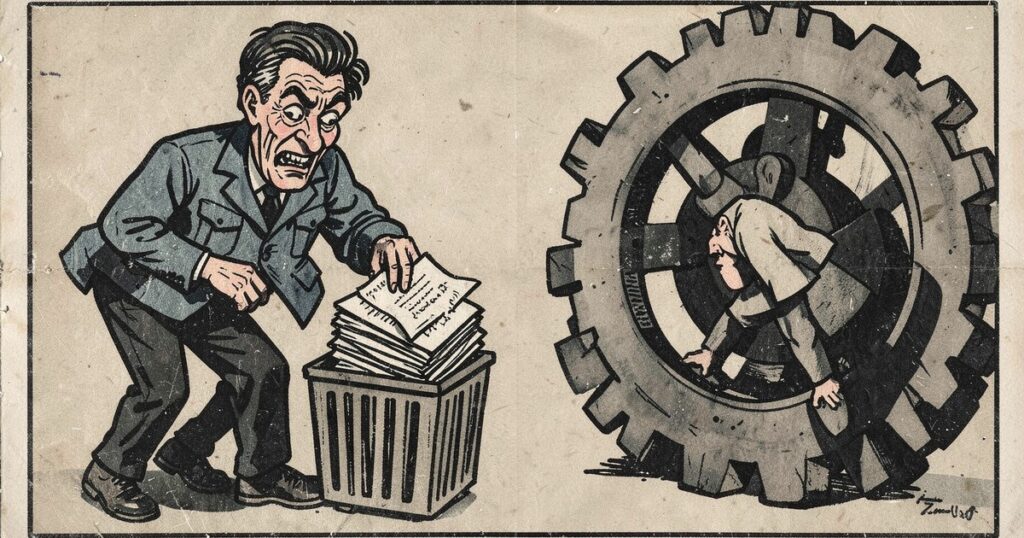

A common misconception about AI in software engineering is the claim that development speed doesn't matter because the business doesn't have enough new ideas.
If you are a team lead, DevOps engineer, or QA engineer, and it seems to you that the business has few ideas, the reason may be different.
The issue is not a lack of business ideas. The business has simply been so ground down by your low productivity, missed deadlines, and tasks repeatedly returning as bugs or rework that it gave up on you. Now it only feeds you the absolutely critical, unavoidable tasks.
Additional work often looks too risky or slow to approve — you slowly poking at your architecture and patterns, only to ship bugs and rework anyway.
In executive discussions I have attended, executives often do not see it this way: that you are doing something vitally important, providing a scalable and maintainable architecture, and accounting for a million edge cases. In many companies, including retail and SaaS, engineering is often treated as a cost center. A recurring cost of delivery.
This is often discussed in financial terms — in terms of ROI, headcount budget, and the cost of delay. One round of bug-fixing after a release, and the CFO calculates the damage not by developer hours, but by lost sales, customer churn, and a dead time-to-market. In this model, developers are an expense line with unpredictable returns.
This framing is usually not shared directly with engineering teams.
They tell you it's very important to ensure business continuity, reliability, delivery guarantees, geo-distributed resilience, low recovery times, data replication, and all that. Organizations often maintain this engineering narrative because it helps align engineering work with delivery goals.
From management's perspective, you can't go to an engineer and say, "Listen, you're a consumable, and your job is to make this feature faster and cheaper." They'll get offended and leave. Or worse, they'll get offended and stay — only now they'll quietly sabotage.
So they tell you a narrative about engineering quality and reliability: SLA, fault tolerance, architectural purity, a culture of engineering mastery. This is partly true — reliability is genuinely needed. But the function of that narrative isn't reliability. The function is manageability. A programmer who believes he's doing important engineering work predictably moves toward a result. A programmer who discovers he's a line item in an Excel spreadsheet does not.
In executive planning discussions, engineering capacity is treated as a cost that management tries to optimize.
I have seen several former team leads struggle with this transition after they were promoted to tech managers. After promotion, some managers shift from engineering concerns to budget and delivery concerns and are forced to treat their former colleagues as replaceable capacity. While it's there, nobody thinks about it; when it runs out, you just replace it.
This shift becomes visible when an architect sits in a meeting with the VP and CEO and suddenly realizes: many engineering priorities — architectural decisions, SOLID principles, code reviews, coding standards — have less weight than financial and delivery metrics. Here they count something else: how much a delayed feature costs in dollars, how many customers were lost last quarter due to a production bug, and by what percentage you can cut the engineering headcount if you shift some tasks to AI.
CTOs and VPs of Engineering aren't buying "architecture" or "processes." They are buying lower operational risk and less coordination overhead. They want to stop jumping at every alert, mediating conflicts between teams, and explaining to the business why the release was delayed again. When offered a way to get the same result with fewer people, they have little reason to reject it on sentimental grounds.
For example.
One company I observed had about $680M in revenue, 15 million customers, and 9,000 employees. The AI transformation didn't come from the bottom up — no enthusiastic developer dragged ChatGPT into the building. The demand was formed at the decision-making level: the initiative was approved and funded by management. Within 6 to 8 months, a separate AI department was carved out. Non-technical staff — marketers, analysts, operations — started building their own tools. Not because they were forced to, but because they could solve some tasks without submitting requests to engineering.
An AI bot connected to the data lake: the time to get an insight went from days, queuing a ticket for the analysts, to seconds. The interaction became a direct question-and-answer workflow, instead of a request, prioritization, waiting, and a report.
Or take another case: a SaaS product with several thousand bugs in the tracker and 5–10 new ones every day. Releases every few months. Clients were afraid to update because something always broke after an update. This is not unusual in some SaaS companies that the business got used to and stopped expecting anything different from.
And it's against this backdrop that AI-assisted development arrives, reducing some tasks from about two weeks to 10–30 minutes. Thousands of automated tests before every commit. No recorded crashes over the next six months.
Claims that clients supposedly don't need AI-assisted coding, that they have no flow of ideas, that everything will stay the same, nobody will be fired, and the same programmers will just sit there and code a little bit with AI do not match these observations.
A common reaction from clients is that the bottleneck has been removed.
They can move small UI changes, query data, and deliver delayed features faster, without waiting for the next quarterly planning cycle.
The limiting factor was often not ideation but tolerance for slow delivery — and AI tools have changed the acceptable delivery timeline.
The claim that "the business doesn't need speed" can function as a defensive argument. It is a reassuring assumption for those accustomed to the current pace and the current status quo. The logic goes: since the client has no new tasks, everything is fine, and I won't be replaced.
Client silence may reflect low expectations after repeated delays, not a lack of demand. Every voiced idea meant months of waiting, rework, estimates of "from 400 hours," and a result that still didn't match the request.
AI-assisted workflows can bypass parts of the traditional engineering queue.
In some cases, this means replacing a team workflow rather than merely accelerating it, or reducing the number of people required for certain tasks.
Replaceable capacity has little leverage once a cheaper substitute appears. Management will compare cost, reliability, and delivery speed against alternatives.