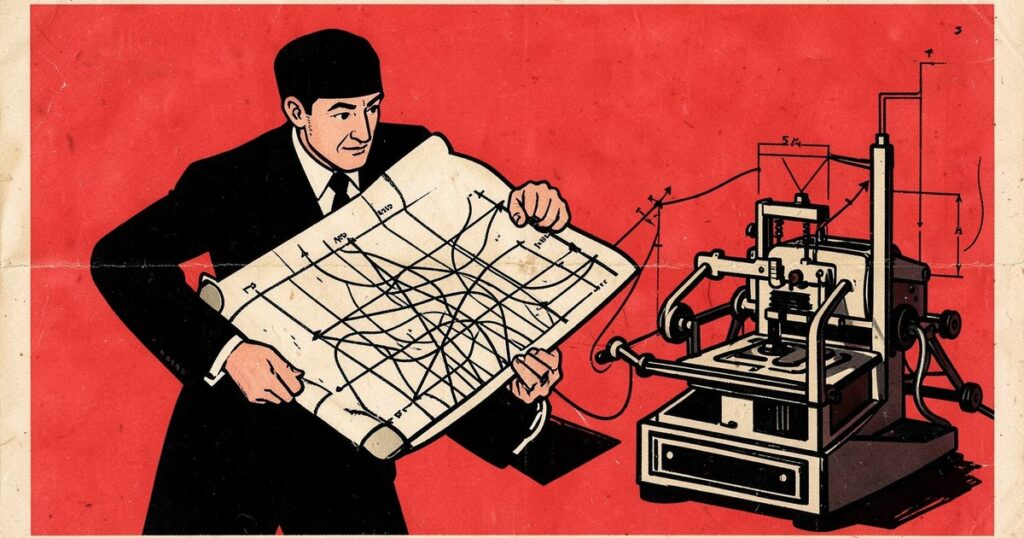

A multinational bank operating across thirty-plus countries just posted a vacancy for a Senior Manager of Enterprise Applications Architecture. The job is remote. The job is also a confession: the bank has a sprawling mess of applications across dozens of subsidiaries, needs someone to draw lines between them, choose which platforms survive, and write reports in both English and Arabic explaining the lines they drew. The automation potential is considerable.
What the human actually does all day
An enterprise applications architect at a bank of this scale is not writing code. They are not even designing systems in the way a solutions architect does. They operate at the layer above the systems — mapping what exists, identifying redundancy, defining standards, and producing artifacts that let other people make decisions. The core deliverables:
- Application landscape diagrams — visual inventories of every piece of software the bank runs, grouped by business capability, with dependencies mapped.
- Architecture decision records — short documents explaining why the bank chose platform X over platform Y, with trade-offs documented.
- Technology standards — curated lists of approved tools, frameworks, and vendors, refreshed periodically.
- Gap analyses — documents identifying where the current landscape falls short of business strategy, with remediation roadmaps.
- Steering committee presentations — slide decks summarizing all of the above for executives who will not read the underlying documents.
It is a job made of documents, diagrams, and decisions. Two of those three things are already automatable. The third is becoming so.
The pipeline that replaces this role
Every component below exists today. Nothing here is speculative.
Discovery and inventory: automated discovery and inventory. Every enterprise already runs discovery tools that scan networks, catalog installed software, and map integrations. The bank almost certainly has this data. An AI agent ingests it, normalizes it, and maintains a living application landscape diagram that updates itself when a new integration appears or a server decommissions. No human draws the arrows. No human updates the Visio file quarterly and emails it to thirty people. The diagram is just there, current, always.
Architecture decision generation: architecture decision generation. When a business unit requests a new platform — say, a digital onboarding tool for a subsidiary in another country — the AI agent does what the human architect currently does. It pulls the bank's existing standards, identifies integration points with current systems, evaluates vendor options against regulatory requirements for that specific jurisdiction, and produces a complete architecture decision record with trade-offs documented. The prompt chain is straightforward: ingest the business requirement, retrieve relevant standards and regulations, query the application landscape for integration points, generate the ADR with citations. A senior manager currently takes days to produce this. The agent takes minutes.
Standards curation: standards curation. Technology standards documents are currently maintained by a human who reads analyst reports, attends vendor briefings, and periodically updates a spreadsheet of approved tools. An AI agent does this continuously — monitoring vendor announcements, security advisories, regulatory changes, and licensing shifts — and proposes updates to the standards list with justifications. A human reviewer can approve or reject. The curation work, the actual reading and synthesizing, is automated.
The bilingual report: the bilingual report. The posting specifically requires English and Arabic communication skills. This is a filtering criterion for humans. For an AI, it is a parameter. Every artifact the system produces — diagrams, decision records, standards updates, gap analyses — is generated in both languages simultaneously. The Arabic is not a translation of the English; both are generated from the same structured source data. The senior manager's bilingual capability, listed as a special skill, is a feature flag.
The steering committee deck: the steering committee deck. This is where it gets uncomfortable for the humans in the room. The AI agent generates the presentation directly from the underlying data — no architect spending an afternoon in slide software, no analyst reformatting charts. The deck includes the landscape diagram, the key decisions made this quarter, the standards changes, and the gap analysis. It is ready to present. Whether a human delivers it to the steering committee is a question of theater, not capability.
Where it breaks
The role has a component that does not automate cleanly: organizational politics. A bank operating across thirty-one countries has subsidiaries with their own IT fiefdoms, their own vendor relationships, their own historical decisions they will defend. The enterprise architect's real job, the part that never appears in the JD, is persuading a country manager that their preferred platform is redundant and should be decommissioned. That conversation involves relationships, hierarchy, cultural nuance, and sometimes the quiet acknowledgment that a particular subsidiary's platform will not be touched because the person who championed it is now a senior executive.
An AI cannot navigate this. It can identify the redundancy perfectly. It can produce the cost analysis and the risk assessment. It cannot sit in a room in another country and read the body language of a subsidiary CIO who is about to lose a system they built their career on. It cannot trade favors across departments. It cannot decide, strategically, to delay a recommendation by one quarter because the political timing is wrong.
The other thing that breaks: regulatory accountability. A bank rated by multiple credit agencies, operating under central bank supervision across multiple jurisdictions, needs a human name on architecture decisions. Not because the human makes a better decision than the AI — they frequently do not — but because regulators require accountability to attach to a person. The architect's signature on a decision record is a legal artifact, not a quality signal.
So the role does not vanish entirely. It shrinks. The architect becomes a reviewer and a political navigator rather than a producer. One person with AI tooling does the work of the current team. The diagrams, the documents, the standards, the bilingual reports — all automated. The meetings, the persuasion, the signatures — still human, but fewer of them, and the humans are less senior because the intellectual heavy lifting is done.
The posting as signal
What makes this vacancy interesting is not the role itself — enterprise architecture roles exist at every large bank. What makes it interesting is that the posting emphasizes re-engineering existing applications and adopting latest technologies. That is the language of a bank that knows its application landscape is bloated and wants someone to clean it up. The irony is that the cleanup work — the mapping, the analysis, the recommendations — is exactly the part an AI system does best.
The bank is hiring a human to do a job that is half automation pipeline already. They will pay a senior manager's salary, require bilingual fluency, and expect presentations to steering committees. Within eighteen months of that person starting, someone in IT strategy will realize that an AI agent can maintain the application landscape diagram in real time, generate decision records in both languages, and produce the steering committee deck without a human touching it. The senior manager will then spend most of their time in meetings, doing the political work the AI cannot do, and signing documents regulators require a human to sign.
If you want to see which roles AI is genuinely consuming, watch what the job postings emphasize. When a vacancy spends more words on communication skills and presentation abilities than on technical architecture work, the technical work has already started to leave the building. Job postings are signals, and this one is signaling that the architect's diagram-drawing days are numbered — they just do not know it yet.
The question is not whether AI can replace this role. The question is whether the bank will admit it before or after hiring someone.