
A European software development company just posted a remote role for a Senior Systems & Software Architect. They want someone to lead architecture across space, ground, and terrestrial segments, design testbed environments, drive DevSecOps pipelines, and attend enough consortium workshops to single-handedly keep the European hotel industry afloat. The wishlist includes Python, C++, Linux, cloud-native, distributed systems, and a willingness to mentor engineers who presumably also know they are about to be automated.
It is a magnificent, sprawling job description. It is also a letter to Santa requesting a human who does what a pipeline of AI agents already does.
The Role That Was Always Just Routing
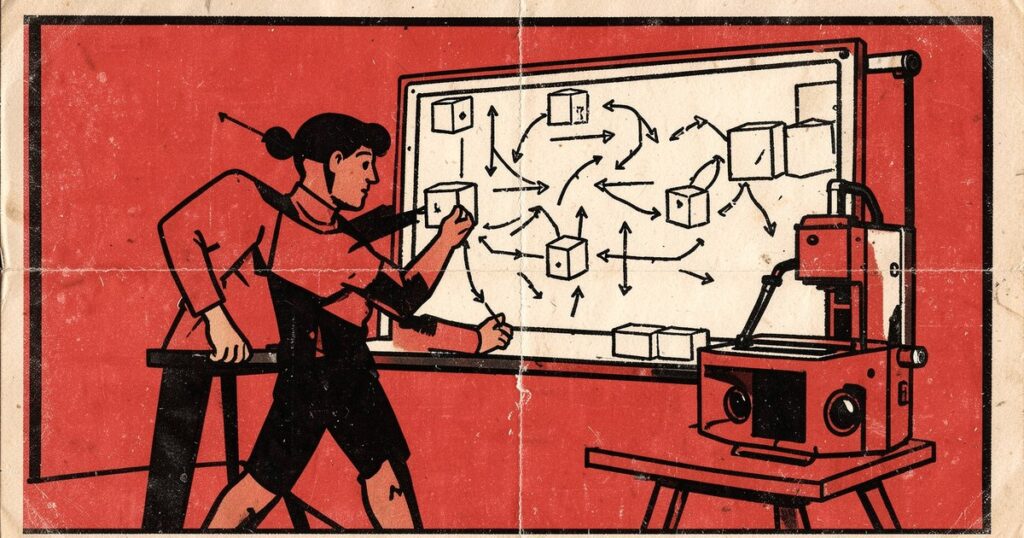
Strip away the acronyms and the cosmic scope, and what does a systems architect actually do day to day? They translate requirements — often vague, regulatory-heavy, and written by committee — into interface definitions, deployment topologies, and software boundaries. They draw boxes and arrows on whiteboards, argue about whether a function belongs in the ground segment or the space segment, and produce documents that other humans read and ignore.
This is an extraction and synthesis job. An LLM with context-window access to the full requirements backlog, the interface control documents, and the legacy codebase is structurally perfect for it. The AI does not need to know how a transponder works. It needs to know how to read a spec, find the contradictions, and emit an architecture that does not violate them.
The Pipeline That Eats the Job
Here is the concrete replacement, phase by phase.
Requirements decomposition
Feed every requirement document, standard, and customer statement of work into a long-context model — 128K tokens or more. The model cross-references each "shall" against the existing interface definitions and flags conflicts, duplications, and ambiguities. A human architect spends weeks doing this. The model does it in minutes and produces a structured table of contradictions that a human then adjudicates in a tenth of the time.
Interface and topology design
The output of decomposition feeds into an agent that generates the actual architecture. It proposes component boundaries, assigns responsibilities, defines data contracts, and emits them as machine-readable schemas — OpenAPI, Protobuf, whatever the stack demands. The AI draws the boxes and arrows. It even writes the Terraform that provisions the boxes. A human reviews the output, shifts a box, approves. The human is no longer the architect. The human is the reviewer.
Testbed generation
This is the part that should make the hiring manager sweat. Testbed environments for satellite communications are supposedly bespoke, high-craft, artisanal engineering. In practice, they are containerized Linux networks with specific latency, jitter, and packet-loss profiles layered on top. An AI generates the Docker Compose files, the network emulation configs, and the mock endpoints that simulate the ground stations. It reads the interface definitions it just wrote and spins up a testbed that conforms to them. The loop closes: the AI designs the system, writes the tests, runs the tests, and files the bug report that it then fixes. The architect was the expensive knot in the middle.
DevSecOps and CI/CD
The JD wants DevSecOps, infrastructure automation, modern deployment. This is the most automated part of any modern engineering org already. AI extends the existing automation by generating pipeline configurations, writing security-scanning rules, and triaging the alerts. The human architect used to be the person who decided which pipeline stage matters. Now the model does that, and the human is the person who nods.
Mentoring and workshops
The JD asks the architect to mentor engineers, promote knowledge sharing, and represent the company in technical forums. An AI agent attached to the team chat answers architecture questions instantly, cites the relevant spec, and never gets tired of explaining the same concept for the fifteenth time. It is a better mentor than most humans because it has actually read the entire documentation repository. As for representing the company in consortium forums — those are largely ritualized consensus processes. An AI can draft the position papers, summarize the meeting transcripts, and track action items. Send a human for the handshake. The AI did the work.
Where It Breaks
Where AI breaks:
Satellite communications involves physical-layer constraints that are genuinely hostile to automation. Link budgets, RF interference analysis, regulatory compliance across jurisdictions — these require engineering judgment that is partly empirical, partly political, and deeply human. An AI can read the ITU regulations, but it cannot sit in a room with a national regulator and negotiate an exception. The consortium activities in the JD are not just technical; they are diplomatic. You cannot send a language model to a steering committee meeting and expect it to form the alliances that get a standard adopted.
Accountability remains. When a satellite deployment fails, someone has to stand in front of the customer and the insurer and explain what happened. That someone is not a model. The model can do the root-cause analysis in seconds. But the human takes the call. The human always takes the call.
Deep technical intuition — the kind that says "this architecture will fall over in three years because the latency assumptions are wrong" — is still partly art. AI can surface the relevant data. A seasoned human still has to make the judgment. Today.
The Catch
The part that breaks is shrinking. The physical-layer constraints are being captured in simulation environments that AI navigates. The regulatory negotiations are being augmented by models that draft better positions faster than any human. The accountability gap is real but is a legal artifact, not a technical one. The moment regulators accept AI-generated compliance artifacts — and they will, because they are cheaper and more consistent — the accountability argument collapses.
What remains is a human who reviews AI output, sits in meetings, and signs things. That is not a Senior Systems Architect. That is a notary with a security clearance.
The vacancy says "if you see systems where others see complexity, and solutions where others see problems." Here is the solution: a pipeline of models that sees the systems, resolves the complexity, and files the output before the human finishes their morning coffee. The problem it cannot solve is why the company is still hiring for the role.
Maybe they need someone to eat the pastries at the consortium workshops.