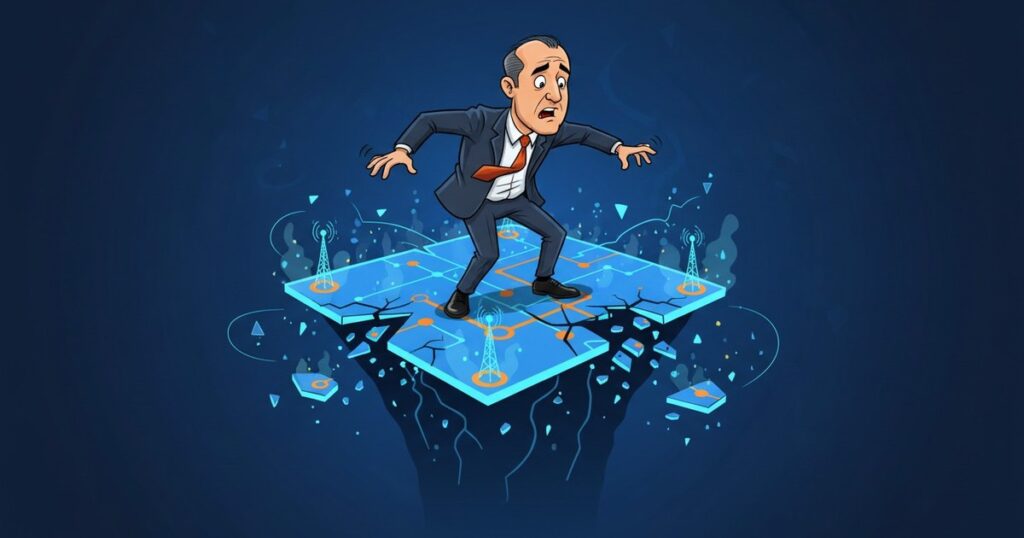

Somebody just posted a job ad. It's looking for a rare creature: fifteen-plus years in telecom, five-plus as a CTO or head of networks, fluent in 5G RAN, IP/MPLS, cloud-native architecture, SDN/NFV, OSS/BSS transformation, and — the best part — "AI and Network Automation." The role is a senior technical leader for telecommunications and enterprise networks at a global IT services giant with a six-digit headcount and customers in ninety countries.
Read that last requirement again. They want a human who is an expert in AI replacing network work, to do the network work that AI is replacing. The ad is a confession with a salary band attached.
So let's do what the ad implicitly asks: how would we replace this person? Not the junior engineer. Not the NOC drone. The executive — the one with board-level presence and a transformation budget bigger than a small nation's GDP.
What This Person Actually Does All Day
Strip away the title and the org-chart mystique, and this role decomposes into four activities.
One: being the technical face in front of customers. The ad calls it "executive technology sponsor" — which means sitting in meetings where a customer asks hard questions, giving confident answers, then going back to the office and checking whether the confident answers were true.
Two: supporting sales. Major pursuits, RFPs, transformation pitches. Translating what the delivery teams can actually build into what the sales teams wish they could promise, and occasionally translating back.
Three: presenting technology strategy to boards, regulators, and investors. Slides. Roadmaps. A narrative that makes a messy multi-year network migration sound like a straight line.
Four: identifying opportunities — new services, API monetization, enterprise networking, digital platforms. Which is a fancy way of saying: reading the market, reading the technology, and having opinions about where the money is.
Now — which of these four survives contact with a large language model?
The Teardown
The customer-facing technical authority automates first, and it automates embarrassingly well. This is the part everyone assumes is safe — executive presence! relationship building! — and it's the most synthetic part of the job. What does a "technology sponsor" actually deliver in a customer meeting? Answers. Accurate, contextual answers about architecture, roadmaps, integration paths, failure modes. That is a retrieval problem. Feed a model the company's solution portfolios, the customer's network documentation, the last forty meeting transcripts, the RFP history, and the regulatory filings — and the answers it produces will be better-sourced than what a human produces after three red-eye flights. The human answers from memory and confidence. The model answers from the actual documents.
The "executive presence" part is a video filter and a good voice model. We have those. The customer will not know, and here's the uncomfortable bit: the customer mostly doesn't care. They care that the answer is right.
The sales-support function is pure prompt engineering. "Translate this delivery team's capability statement into a compelling pursuit narrative for a tier-one carrier, emphasize network slicing and API monetization, keep the compliance section accurate." That's not a job. That's a paragraph. The eternal tension this person arbitrates — what sales wants to promise versus what engineering can deliver — becomes a loop between two models with a human approving the final delta. The delta is small. The delta has always been small.
The board presentations write themselves. A technology strategy deck for a board is the most formulaic artifact in enterprise telecom. Current state, industry trends, phases, a migration diagram with arrows, a risk slide, a budget slide. Models generate these in minutes and, more importantly, revise them in minutes — which matters because the real work of board decks is the eleven rewrites after the CFO changes the numbers. The executive who takes two weeks per revision cycle is competing against something that takes two minutes. That's not a competition; that's a hostage situation.
The opportunity-identification piece is where it gets genuinely funny. "Identify opportunities for new services, API monetization, enterprise networking." A model that ingests carrier announcements, standards-body releases, spectrum auctions, enterprise IT spending reports, and competitor press releases will surface more opportunities, with better citations, than any individual who learned the industry in 2008. The fifteen years of experience this role demands are precisely the asset that depreciates fastest — because the industry's frontier has moved to exactly where the model's training data is freshest.
Where It Breaks
Now the catch, and it's a real one. Three things in this role do not automate cleanly.
Regulators and government don't negotiate with software. The ad asks for someone who builds relationships "across customers, regulators, partners, and government." Australian telecommunications is one of the most regulated industries on the planet — spectrum policy, interception obligations, critical infrastructure rules, national security clearance culture. A regulator will not take a meeting with a chatbot, and the trust networks in that world take a decade to build. Nothing can ingest them. This is the one part of the role where the human is genuinely load-bearing.
The AUD $50M transformation program has a political layer that no model can carry. When a multi-year network migration slips — and it will — someone has to walk into a room full of angry stakeholders and absorb the blame while keeping the program alive. That's not technical leadership. That's being the designated adult. Models don't get to be the designated adult, because nobody will accept a machine's apology on behalf of a slipped milestone. Accountability is the last human monopoly.
And the network itself still occasionally requires a human to look at it. Not often — the OSS/BSS transformation and network automation this person is supposed to champion are precisely the tools that emptied the NOC — but when a routing anomaly cascades across a carrier backbone at 3 a.m., the automated remediation either fixes it or escalates to a person, and that person needs the fifteen years of scar tissue the ad asks for. The catch is that this is maybe five percent of the role. We're keeping a human for five percent and paying them for a hundred.
The Verdict
So here's the shape of it. Four core activities: two automate almost entirely, one automates with a human approving deltas, and one — the regulator-and-blame function — stays human for now. That's not a job description anymore. That's a part-time advisory gig with a very good expense account.
The deepest irony is in the ad's own words: they want a leader with expertise in "AI and Network Automation" — someone whose defining skill is replacing network work with software — hired to do network work that software can increasingly do. It's the last boomerang specialist: the person whose job is to eliminate the category of person who does their job.
The company posting this vacancy believes it needs a person. The vacancy itself is evidence that somewhere, a model is already drafting the strategy deck, answering the customer's questions, and scanning the market for the next opportunity. The only question left for whoever gets hired is whether they'll be the executive technology sponsor — or the last item on its own transformation roadmap.
Enjoy the corner office. It has excellent natural light for reading your own redundancy notice.