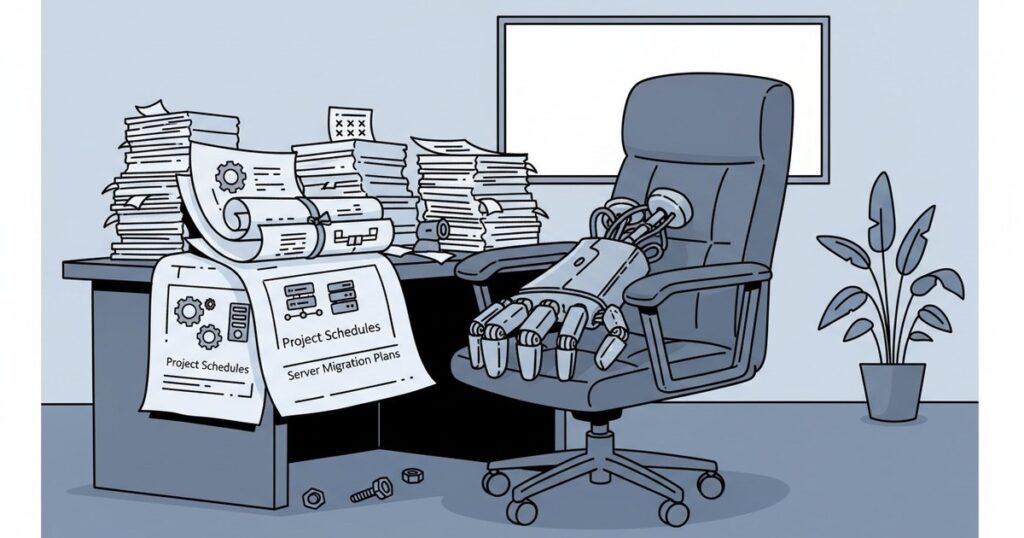

A European retail company is hunting for a freelance CTO — two to three days a week, through February, renewable. The job is to oversee five to six concurrent web projects, manage hosting migrations, handle pre-sales, and maintain a PHP/Symfony stack across corporate sites and e-commerce platforms. Read that description carefully. It is a confession that every task listed follows rules, patterns, and constraints a machine can hold simultaneously without forgetting one.
What the Role Actually Does
Strip the title and look at the work. A freelance CTO at a creative agency is a dispatcher. Five to six projects run in parallel — corporate site refontes, secure platforms, e-commerce, landing pages with tracking. The CTO coordinates a four-person team: a Lead Front Dev, a Back Dev, a Project Owner, and a Digital Project Manager. They smooth processes between creative, project managers, and developers. They step into maintenance tickets. They interface with hosting providers for server migrations. They plan PHP and CMS version upgrades and advise clients on technical maintenance contracts.
Then there is the pre-sales work: challenging creative concepts for technical feasibility, writing technical recommendations, estimating workloads, and contributing to new service offerings around acquisition, data, and AI.
This is not vision work. It is not architecting a novel distributed system. The posting explicitly says so: "a global and decisional vision is expected, without a pure network architect role." It is coordination, estimation, risk management, and communication. It is a routing problem with a documentation problem sitting on top of it.
How AI Takes the Delivery Layer
The five-to-six concurrent projects are the easy part. An AI system with access to the project management board, the Git repositories, and the hosting infrastructure dashboards becomes the daily coordinator.
The pipeline works like this. A large language model ingests the project board every morning — statuses, blockers, deadlines, dependencies. It cross-references each project's spec against the current state of the codebase. Where a creative concept requires a new front-end component, the system checks whether one already exists in the agency's component library. Where a backend feature needs a new Symfony controller, it drafts one, opens a pull request, and assigns the Lead Dev for review. The four-person team stops being a team that writes code and becomes a team that reviews AI-generated code — a ritual that, as some have argued, is already becoming employment theater.
The RUN and maintenance tickets are even simpler. A refont of a corporate site on a flat-file CMS, a version bump from PHP 7.4 to 8.2, a security patch on a PHP-based e-commerce instance — these are deterministic tasks with known patterns. The system reads the ticket, identifies the affected repository, generates the diff, runs the test suite in a Docker container identical to production, and opens the PR. The human reviews, merges, and the deployment pipeline handles the rest. The CTO's job of stepping into maintenance tickets becomes a queue that clears itself.
How AI Takes the Hosting and Security Layer
The posting wants someone to pilot hosting environment refonts, interface with third-party hosts, and manage client server migrations. This is phone calls and ticket exchanges with infrastructure providers, plus planning a migration sequence that doesn't take the client's site offline on a Tuesday afternoon.
An AI agent handles this by interfacing directly with hosting provider APIs. It queries the current server state, drafts the migration plan, schedules the DNS cutover for the lowest-traffic window based on analytics data, and executes. The "interface with third-party hosts" part — historically a reason to hire a human who knows how to talk to major hosting providers' support teams — dissolves when the agent can open a support ticket itself, parse the response, and act on it.
Version upgrades follow a schedule. The system tracks every client site's PHP version, CMS version, and dependency tree. When a security advisory drops, it flags the affected sites, generates the upgrade PR, and notifies the project manager to coordinate client approval. Version upgrade planning is a cron job with a judgment layer.
How AI Takes the Pre-Sales Layer
This is where the CTO's human value was supposed to be safe. Challenging creative feasibility, writing technical recommendations, estimating workloads — that is expertise, right?
It is pattern matching. The agency has built dozens of corporate sites, e-commerce platforms, and landing page systems. Every past project has a spec, a timeline, a budget, and an outcome. Feed those into a retrieval-augmented model. When the creative team proposes an interactive 3D product configurator for a client's new acquisition campaign, the system pulls the last three times the agency attempted something similar, notes the hours actually spent versus estimated, flags the integration risks with the client's existing CMS, and drafts the technical preconisation document in the agency's house style.
The workload estimation is where this gets uncomfortable for humans. A CTO estimates based on experience. A model estimates based on every project the agency has ever delivered, weighted by similarity to the current brief. It is not more creative. It is just less forgetful.
Contributing to new offers around acquisition, data, and AI? The system that writes the pre-sales docs can write the service offering docs too. The "AI" offering the agency wants to sell to clients is the same AI running the agency's own pre-sales. That is not irony. That is a business plan.
Where It Breaks
Here is the catch, and it is a real one.
The creative agency's clients are large accounts and institutional organizations. These clients have procurement processes. They require a named technical lead on the contract. They want to see a human in a meeting who can look their IT director in the eye and promise the migration won't break their SSO. They need someone to blame when it does.
The AI can draft the migration plan, execute it, and write the incident report. But it cannot sit in a room in La Défense and absorb the political anxiety of a client who is spending six figures on a website refont and needs to report to their own board that "we have a CTO handling it." Absorbing that anxiety is a human job. It is theater, but it is paid theater, and the agency bills for it.
The other break is taste. When the creative team proposes something genuinely novel — a format the agency has never built, an interaction pattern that doesn't exist in the component library — the model can only say "I don't have a reference for this" and defer. The CTO's job in that moment is to invent a path forward, not retrieve one. That happens in maybe ten percent of the work. But it is the ten percent that justifies the other ninety.
The Verdict
This posting asks for two to three days a week of a human's time to do coordination, estimation, maintenance scheduling, and pre-sales documentation. The machine can do ninety percent of that now. The remaining ten percent — client face time, novel architecture decisions — is what the agency is actually paying for. They just don't know it yet, because they wrote the job description as a list of tasks instead of a list of moments that matter.
If you are the freelancer who takes this contract, enjoy the rate. But know that every pre-sales document you write, every migration plan you draft, and every version-upgrade schedule you maintain is training data for the system that replaces the next person in that chair. The job posting says renewable. It is — until it isn't.