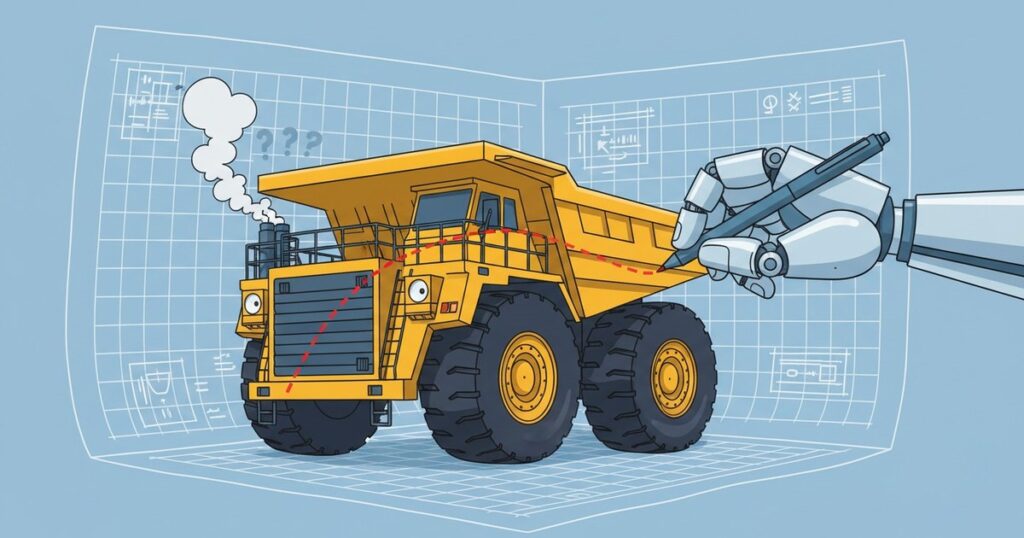

An Australian mining company just posted a vacancy for a Lead Platform Architect — AI Platform. The role involves translating business requirements into secure, scalable, reusable AI capabilities, designing for generative AI, large language models, intelligent agents, retrieval, orchestration, and enterprise integration. They want security, governance, operational readiness, reference implementations, and mentorship. This is a job posting that admits a human still does what a machine could do.
What the Role Actually Does
A Lead Platform Architect at a resources company is not building a product. They are building the substrate on which other people build products. The job is 70% decisions about tradeoffs that will not be visible for two years, 20% writing documents that justify those decisions, and 10% hands-on prototyping to prove the tradeoffs are real.
The day-to-day looks like this: someone wants to deploy a retrieval-augmented chatbot for the operations team. The architect decides whether it runs on a managed service or on self-hosted infrastructure, whether the embeddings live in a vector store the company already owns or a new one, whether the agent framework is something they buy or something they build, whether the guardrails are in the prompt or in a separate policy layer, whether the audit log goes to the existing SIEM or a new pipeline, and whether the cost is billed to the operations team or absorbed by the platform.
None of those decisions have a single correct answer. They have answers that are defensible given the company's constraints — existing cloud contracts, data residency obligations, the maturity of the engineering team, the risk appetite of the security team, the budget cycle, the political weight of whoever wants the chatbot. The architect's job is to make those tradeoffs visible and pick.
What Automates First
The documentation automates first. Not the architecture itself — the artifacts that justify the architecture.
A platform architect produces three kinds of output: technical roadmaps, architecture decision records, and reference implementations. The first two are text documents with structure. The third is code that proves the first two are not fiction. An AI system can produce all three today, and crucially, it can produce them faster than the meetings required to align humans on them.
The concrete pipeline:
1. Requirement ingestion. The AI reads the incoming request — a business need from operations, a capability gap from product, a compliance mandate from security — and classifies it. It maps the request against an ontology of platform capabilities already built and identifies whether this is a net-new capability, an extension of an existing one, or a duplicate. For a mining company, the ontology includes things like "geospatial data pipeline," "real-time asset telemetry," "predictive maintenance model serving," "safety incident retrieval," "exploration data synthesis." The AI does not need to guess what the company does; it reads the job description and the existing architecture documents.
2. Tradeoff analysis. For each viable option, the AI generates a tradeoff matrix: cost, latency, vendor lock-in, team skill requirement, security posture, operational burden, time-to-value. It pulls the company's existing constraints from a knowledge base — current cloud provider, data residency rules, existing SIEM, identity provider, procurement cycle length — and filters options accordingly. It does not produce a recommendation. It produces a decision package with the top three options, each with a one-page tradeoff summary and a reference implementation sketch.
3. Reference implementation. For the chosen option, the AI generates a working prototype — a Terraform module, a Dockerfile, a skeleton service, a prompt template, an eval harness. This is the part that would normally take a senior engineer two weeks. The AI does it in an afternoon, not because it is smarter, but because it has the entire pattern library of "how do you deploy a retrieval-augmented LLM application" in its training data and can pattern-match against it.
4. Architecture decision record. The AI writes the ADR: context, decision, consequences, alternatives considered, compliance notes. It follows the company's existing ADR template. It cites the tradeoff matrix. It flags the decisions that are reversible and the ones that are not.
5. Roadmap update. The AI inserts the new capability into the existing technical roadmap, re-prioritizing based on the company's stated criteria — business value, technical debt, risk. It produces a diff against the previous roadmap, not a rewrite.
The human architect in this loop is the reviewer, not the author. They read the decision package, they check the tradeoff matrix against their own knowledge of the company's politics, they approve or reject, they occasionally override. The AI has done the work that used to justify the architect's salary; the human now does the work that justifies their judgment.
What Automates Second
The reviews automate second. The job description lists "architecture reviews, prototypes, implementation guidance, resolution of complex technical challenges" as key responsibilities. These are meetings. They are meetings where a human stands in front of other humans and defends decisions, answers questions, and absorbs political pressure.
An AI system cannot stand in front of a room of engineers and say "this is why we chose the managed vector store over the self-hosted one" with the kind of conviction that makes the room trust the decision. But it can do something else: it can prepare the defense so thoroughly that the human in the room sounds like they have thought about everything.
Before every architecture review, the AI generates a briefing: the likely objections, the person most likely to raise each objection based on their role and history, the data that addresses each objection, the fallback position if the objection is sustained. The human architect walks in with a one-page brief and survives the meeting. The AI has not replaced the architect in the meeting. It has replaced the architect at 11pm the night before.
The Pipeline, Specifically
For a mining company's AI platform, the concrete pieces an AI system would build:
- Capability ontology. A graph of what the platform can do, stored in a format the AI can query. When someone says "we need predictive maintenance for haul trucks," the AI maps that to "time-series anomaly detection on telemetry streams" and checks whether the platform already has that capability or needs to build it.
- Tradeoff engine. A function that takes a capability request and the company's constraints and returns ranked options. For "retrieval-augmented chatbot for operations," it returns: (a) managed RAG service on existing cloud, (b) self-hosted RAG on existing Kubernetes, (c) fine-tuned model on existing GPU cluster. Each with a cost curve, a latency profile, a lock-in score, a security posture.
- Reference implementation factory. Given a chosen option, generate the Terraform, the Dockerfile, the prompt template, the eval set. For a mining company, the eval set includes real operational queries — "what is the payload capacity of truck 47" — and the expected answer, drawn from the asset database, so the eval is grounded in the company's actual data, not synthetic benchmarks.
- ADR generator. Takes the decision, the tradeoff matrix, the reference implementation, and produces the document in the company's template. Cites the existing architecture standards it complies with. Flags the compliance requirements — data residency, sovereign cloud, indigenous data governance — that apply to a resources company operating in Australia.
- Roadmap differ. Compares the new capability request against the existing roadmap, produces a diff, identifies conflicts — "this capability requires a data pipeline that the data team has not prioritized" — and surfaces them for human resolution.
Where It Breaks
Here is the honest part. The automation breaks at accountability.
A platform architect's real job, the part that is not in the job description, is absorbing blame. When the retrieval pipeline returns a hallucinated answer and the operations team loses trust in the chatbot, someone has to stand up and say "this is my design, here is why it failed, here is what we change." When the cloud provider raises prices 40% mid-contract and the CFO asks why the platform bill tripled, someone has to explain that the tradeoff was "managed service for velocity" and the velocity is no longer worth the premium. When the security team fails an audit because the guardrail architecture had a gap, someone has to own the gap.
An AI system can write the post-mortem. It can write the root cause analysis. It can write the remediation plan. It cannot be the person whose name is on the decision record. The governance frameworks of large companies — especially regulated ones like resources operations — require a human to sign the ADR. Not because the human is smarter, but because the human is sackable. Accountability requires a throat to choke. The AI has no throat.
This is why the role survives. Not because the AI cannot do the work. Because the work includes being the entity that the org punishes when the work goes wrong. The job description does not say this. It says "drive platform architecture, technical roadmaps, adoption of innovative AI solutions." It does not say "be the named defendant in a post-incident review." But that is the job.
The Catch
The AI system needs the company's existing architecture as input. It cannot architect a platform in a vacuum. The first month of the AI's work is ingesting every architecture document, every ADR, every cloud account configuration, every data pipeline spec, every security policy, every procurement contract the company has. This is the part the job description calls "collaborate with cloud, infrastructure, data, security and integration teams to manage dependencies." It is the unglamorous part. It is the part that determines whether the AI's subsequent output is grounded or hallucinated.
A mining company has an additional catch: the data is not software data. The AI platform serves geospatial data, telemetry streams, exploration datasets, asset registries. The architecture patterns for these are different from a SaaS company's patterns, and the AI system has to know the difference. If it pattern-matches against generic "AI platform" training data, it will propose a vector store for embeddings when the company actually needs a time-series database for sensor data. The ingestion phase has to include the company's data shape, not just its org chart.
The Verdict
The company is not hiring an architect to design. They are hiring an architect to own. The AI designs. The human owns. That is the deal, and it is the only deal that works inside a governance framework that requires a throat.
If you are the candidate, walk into the interview and ask: who signs the post-mortem? The answer tells you whether the role is real or whether it is a title in front of a pipeline that has already been built.