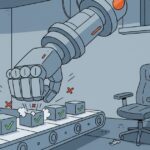

A software development company in Australia just posted a vacancy for a Lead Engineer in its Internal AI Accelerator Squad. The pitch asks for a "forward-deployed engineer" to embed with business teams, co-design "agentic workflows," and remove manual toil. The quiet punchline is that the blueprint already exists, the tools are off-the-shelf, and the act of stitching them together is exactly what the tools themselves are now best at.
The company is hiring a human to build the system that will make the human obsolete. The human's first task would be to write the automation that renders their own role a ceremonial checkbox. Let's walk through what this Lead Engineer actually does, and how an AI system — built from the exact stack listed in the job description — takes the seat.
The Real Job, Stripped of "Vibe"
The job description outlines a familiar archetype: a technical translator who sits between a messy business process and a set of APIs. The work is "discovery" (finding the toil), "design" (mapping it to a workflow), and "operationalization" (writing the code that connects an LLM to the enterprise platforms). The tools are named outright: Claude, Gemini, MCP (Model Context Protocol), and a roster of SaaS systems with open APIs.
This is not deep, greenfield algorithmic research. It is systems integration. The Lead Engineer is a plumber. A well-paid, evangelizing plumber who uses the word "agentic" in meetings, but a plumber nonetheless. And plumbing is exactly what AI does well, because it is a constrained problem with clear success criteria: data goes in, a transformation happens, data goes out, a system of record gets updated.
The Pipeline That Eats the Job
Here is how you replace the Lead Engineer with the stack they are supposed to build.
Phase 1: Automated Discovery. Instead of a human embedding with a team for two weeks to map a workflow, you point a transcript-analysis agent at the team's recorded meetings, their Slack channels, and their support tickets. An LLM with access to these data sources identifies the repetitive patterns: "Every Thursday, someone pulls a report from the HR system, formats it, and pastes it into a shared document." That is the toil. The AI found it in minutes, not weeks.
Phase 2: Scaffold Generation. Once a toil pattern is identified, a code-generation model writes the orchestration. The job description mentions MCP — a protocol for giving models tool access. The pipeline is trivial: an LLM is given a goal ("reconcile this weekly report"), a set of MCP tools (read from the HR platform, write to the document platform), and a constraint template. The model generates the Python or TypeScript scaffold. It writes the API calls, the error handling, and the logging. The "reusable automation patterns and shared templates" the human was supposed to design? The AI generates them from the existing codebase as a matter of course, because pattern recognition is the core competency of a language model.
Phase 3: The Guardrails. The job description asks for "evaluation and monitoring frameworks to measure performance and ensure safety." This is the last refuge of the human expert — the idea that a human must define the guardrails. But guardrails are themselves code, and they are highly templatable. You instruct a model to generate a set of assertions: "Does the output contain PII? Flag it." "Does the API call exceed budget? Halt it." "Does the agent deviate from the approved tool list? Roll it back." The generation of these tests is a standard prompt. The execution is automated. The monitoring is a dashboard.
The "Vibe-Coding" Trap
The job description uses the term "vibe-coding" — a trendy phrase for building software by interacting with AI in a flow state, accepting outputs iteratively. It sounds modern and agile. It is actually the sound of the role dissolving.
If the Lead Engineer's method is "vibe-coding" — directing an AI to generate the integration code, testing it, adjusting the prompt, and shipping — then the only human bottleneck in that loop is the person typing the prompt. And the prompt itself is a compressed version of the business requirement. The business team already knows the requirement. They told the discovery agent in Phase 1. The loop closes. The business user describes the outcome; the AI generates the workflow, the tests, and the guardrails; the system deploys it to a sandbox; the user approves it. The Lead Engineer is a middleman in a conversation that no longer needs a translator.
Where It Breaks
This is not a clean sweep. The catch is accountability and access.
The enterprise systems in question — the CRM, the ERP, the HR platform — hold the company's crown jewels. An AI agent can write the code to update a financial record in the ERP, but no sane organization will let an autonomous system push that code to production without a human signing off. The breakage is institutional. The Lead Engineer survives not because they write the code (they won't, soon) but because they hold the API keys. They are the human signature on the change request. They are the person who gets fired if the agent deletes a table instead of updating a row.
The other breakage is "messy workflows" that are not actually workflows at all. The job description promises the transformation of "complex, messy workflows into elegant, automated solutions." But many messy processes are messy because they are political. An agent cannot automate "I need to get approval from Sarah, but Sarah is on leave and her backup doesn't have the context, so I just do it myself and ask for forgiveness later." That is an organizational dysfunction. The AI will hit it and stop. A human navigates it by walking to a desk or sending a pointed message. The human survives as a political actor.
The Verdict
The company is hiring a Lead Engineer to build an AI accelerator. The accelerator's output is automated workflows. The process of building those workflows is itself a workflow. It will be automated. The job posting is a snake eating its own tail.
The human who takes this role will spend six months building the scaffolding, the MCP integrations, and the prompt templates. In month seven, they will realize the scaffolding can build itself. In month twelve, they will be the person clicking "Approve" on a dashboard, watching the system they designed do their job without them. The core role of people in software development is over — not because the coding stopped, but because the coding became a thing the code does.
So here is the dare to whoever takes this job: build the system. Build it well. But do not pretend you are building a tool. You are building your replacement. And the company that posted this vacancy already knows it. They just needed a human to press the start button.