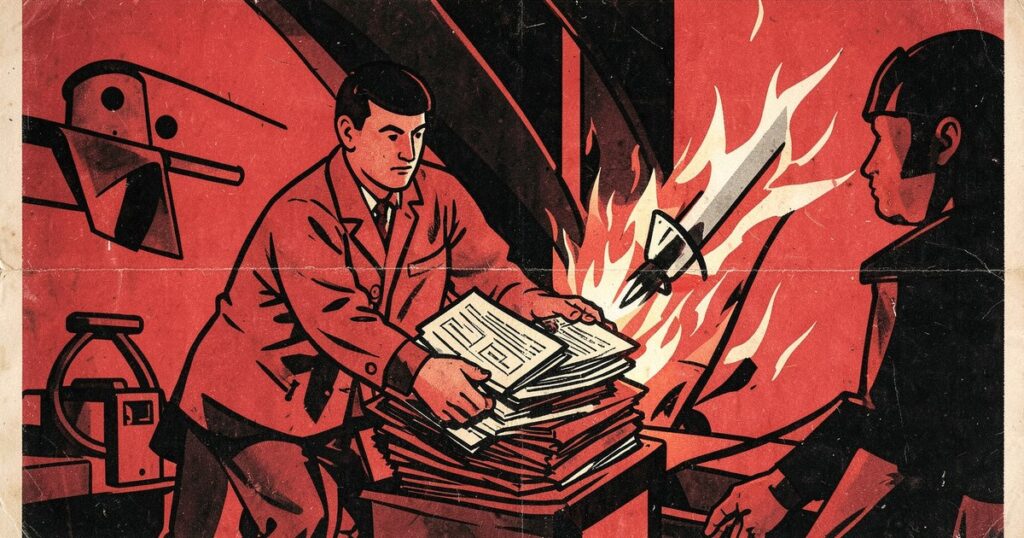

A propulsion technology company in the UAE just posted a job for a Principal Casting Engineer. They want fifteen years of hands-on experience, deep expertise in single-crystal turbine airfoils, and someone who can look at a wax die, a ceramic core, and a vacuum induction melting furnace — and know exactly where the freckles will form. They want a wizard. And they're about to find out that wizards are expensive, slow, and annoyingly opinionated.
Here's how you replace this specific wizard with a system. Not a chatbot, not a toy — an actual pipeline that does the metallurgy, the tooling strategy, the defect resolution, and the qualification planning. The same way a senior casting engineer does it, but without the salary, the ego, or the need to fly to the UAE.
What the Role Actually Does
Before automating it, let's be honest about what a Principal Casting Engineer does day to day, because the job description is doing its best to hide it.
This person is the final technical authority on investment casting for aero-engine components. That means turbine blades — the unsexy, brutally difficult parts that experience temperatures above their own melting point while spinning at 15,000 RPM. The casting process for these is genuinely one of the hardest manufacturing problems in human industry. You melt a nickel-based superalloy in a vacuum, pour it into a ceramic shell built around a wax pattern, control the solidification down to the grain level, and pray you didn't introduce porosity, freckles, or recrystallization. Get it wrong and the blade fails a non-destructive test. Get it wrong in a way that passes NDT but fails in service and people die.
The Principal Engineer is the person who has seen enough blades fail to know why. They pick the alloy. They design the gating and feeding. They choose the grain selector geometry. They specify the wax die, the ceramic core tooling, the shell system. They run solidification simulations in commercial casting simulation software and interpret the results — not just "is there a defect predicted" but "is this defect real or a meshing artifact, and does it matter given where this casting sits in the engine." They write the process specification. They write the qualification plan. They mentor junior engineers who are supposed to become them someday.
Fifteen years of this and you have a person whose brain contains an enormous, tacit, hard-won library of casting defects, alloy behaviors, and furnace quirks. That library is what the company is paying for.
That library is exactly what the system needs.
The Replacement Pipeline
Here's how you build the system that replaces this person. Not in five years. Now, with tools that exist today, assembled by a small team that understands both metallurgy and ML.
Layer 1: The Knowledge Base
You start by ingesting everything. Every casting defect report the company has ever produced. Every NDT result. Every furnace log from every vacuum induction melt. Every wax injection parameter record. Every shell build record. Every heat treatment cycle. Every grain inspection photo. Every single-crystal growth log. Every alloy certification sheet. Every solidification simulation result the company has ever run, including the ones that didn't match reality — especially those.
This is not a small dataset. A company that has been casting aero-engine blades for any meaningful period has decades of process data sitting in LIMS systems, MES records, defect databases, and the personal hard drives of engineers who retired. You extract all of it, structure it, and link it: this alloy, poured at this temperature, in this furnace, with this shell, through this gating, produced this grain structure, with these defects, confirmed by this NDT, validated by this metallographic section.
You now have the tacit library in machine-readable form. The thing that takes fifteen years to build in a human brain takes a data engineering team a few months to assemble into a vector store with relational joins.
Layer 2: The Simulation Interpreter
The Principal Engineer runs a solidification simulation and interprets the result. The simulation says there's a temperature gradient of 4°C/mm at the solidification front. The human knows from experience whether that's enough to avoid freckle formation in this alloy at this section thickness. The AI doesn't need to intuit it — it has the historical record. It can query: every time this alloy was cast with a gradient between 3.5 and 4.5°C/mm in a section of this thickness, what was the freckle defect rate? It gets an answer in seconds. The human gets a guess in minutes.
You build this as a retrieval-augmented system that takes simulation outputs and cross-references them against the historical casting database. The output isn't "defect predicted: yes/no." The output is "this configuration is similar to 340 historical casts, of which 12 developed freckles, all associated with shell preheat below 1050°C. Recommend increasing preheat to 1080°C, which in historical record reduced freckle incidence to 2 out of 180 casts." That's better than what the Principal Engineer gives you, because the Principal Engineer can't remember 340 casts. They remember the bad ones, which is useful but biased.
Layer 3: The Tooling and Process Generator
Here the replacement stops being documentation and becomes process design. The job asks the Principal Engineer to define tooling strategies — wax dies, ceramic core tooling, shell systems, grain selectors, starter blocks. These are geometric and process decisions. The AI approaches them as a constrained optimization problem.
You give the system the blade geometry (already defined by the aero-engine design team). You give it the alloy. You give it the furnace capabilities. The system proposes a gating and feeding design based on solidification simulation runs — which it can kick off and iterate through automatically, running hundreds of simulation configurations overnight, each one evaluated against the historical defect database. By morning it has tested more gating configurations than a human engineer could run in a year.
It won't always be right. It will sometimes propose something that a senior casting engineer looks at and says "that wax die won't demold cleanly" or "that core has a section that will crack during dewax." Fine. You add a geometry validation step — a physics-informed check on demoldability, core stability, shell drying. This is computable. Wax die demoldability is a geometric constraint problem. Ceramic core stability during dewax is a thermal-mechanical simulation. These are things we can model.
Layer 4: The Specification and Qualification Writer
The job wants process specifications, qualification plans, and training curricula. This is the part that sounds most human and is actually most robotic. A process specification for investment casting of a nickel-based superalloy blade is a structured document with sections on melt practice, pouring temperature, shell preheat, vacuum level, withdrawal rate, primary and secondary dendrite arm spacing targets, NDT acceptance criteria, and heat treatment cycles. It follows templates. It references standards. It has ranges and tolerances derived from the process window established during qualification.
An LLM with access to the historical process database, the simulation results, and the relevant standards writes this document. Not perfectly on the first pass. But it writes a draft that a junior engineer can review and finalize in an afternoon instead of a week. The qualification plan — which castings to make, what tests to run, what acceptance criteria to use — is generated from the same data. The training curriculum is a summary of the specification with pedagogical scaffolding. All of this is template-driven work that has been done by senior engineers for decades because no one else had the context. Now the system has the context.
Layer 5: The Mentor
The job wants the Principal Engineer to mentor junior engineers. Most mentoring in technical roles is answering the same questions repeatedly. "What's causing this porosity?" "Is this grain structure acceptable?" "Why did this blade fail HIP?" The AI mentor doesn't get tired of answering. It doesn't have a meeting at 2. It doesn't say "go look it up." It pulls up the relevant historical casts, the simulation results, the defect images, and walks the junior engineer through the diagnosis. It is, genuinely, a better mentor for the first ten years of a casting engineer's career than most humans, because most humans are bad at mentoring and don't have time.
Where It Breaks
The system fails at the boundary of novelty.
The system fails at the boundary of novelty. When the company introduces a genuinely new alloy — one not in the historical database — the AI is flying blind. It can run simulations, but it can't cross-reference against historical casts because there aren't any. A senior casting engineer with fifteen years of experience has transferred intuition across alloys before. They know that a new nickel-based superalloy with higher rhenium content will behave like alloy X but with a narrower processing window. The AI can attempt analogical reasoning from composition similarity, but this is exactly where metallurgy gets ugly. Small composition changes produce non-linear behavior changes. The freckle resistance of a superalloy is not a smooth function of its composition. The AI will be wrong in ways that are hard to predict, and in casting, wrong means scrap or worse.
The system also fails at equipment-specific knowledge. Every vacuum induction melting furnace has a personality. Thermocouple placement, coil degradation, leak rate behavior, the specific way it ramps. This is not in any database because nobody writes it down. The Principal Engineer knows it because they've stood next to that furnace for years. The AI would need instrumented furnace data — real-time, high-frequency, permanently logged — to learn each furnace's behavior. Most casting shops don't have that instrumentation. Without it, the system is making furnace-agnostic recommendations that a human still has to adjust.
And the system fails at the political layer. The job says "support partner technical evaluation." That means sitting across the table from a supplier or a customer and arguing about who is responsible for a defect. The AI can prepare the technical case. It cannot sit in the room and read the body language of the supplier's metallurgist who is lying about their shell preheat temperature. That's a human skill, and it's load-bearing in this role.
The Verdict
So the Principal Casting Engineer doesn't vanish. They shrink. One person with the system does the work of three. They stop running simulations and interpreting them — the system does that. They stop writing specifications — the system drafts them. They stop answering junior engineers' questions — the system handles those. What remains is the genuinely hard part: novel alloys, furnace personalities, and the political cage-fighting of defect responsibility.
The company posted this job asking for fifteen years of experience. They'll find someone. That person will spend their first six months building the institutional knowledge base that makes them redundant. Not because anyone planned it that way, but because the first thing a good Principal Engineer does when they arrive is document everything — and documentation is the prerequisite for automation.
The job posting itself is the signal. A company hiring a Principal Casting Engineer today is a company that has decided the knowledge of their retiring senior metallurgists must be captured in a single hire. They're right. They just don't know yet that "captured" and "replaced" are going to turn out to be the same word.
The same pattern shows up in AI job demand signals. The fifteen-year expert is the last interesting hire a casting department will ever make. After this one, the job posting will read "Casting Process Technician — data entry and furnace monitoring." And that posting will be honest.