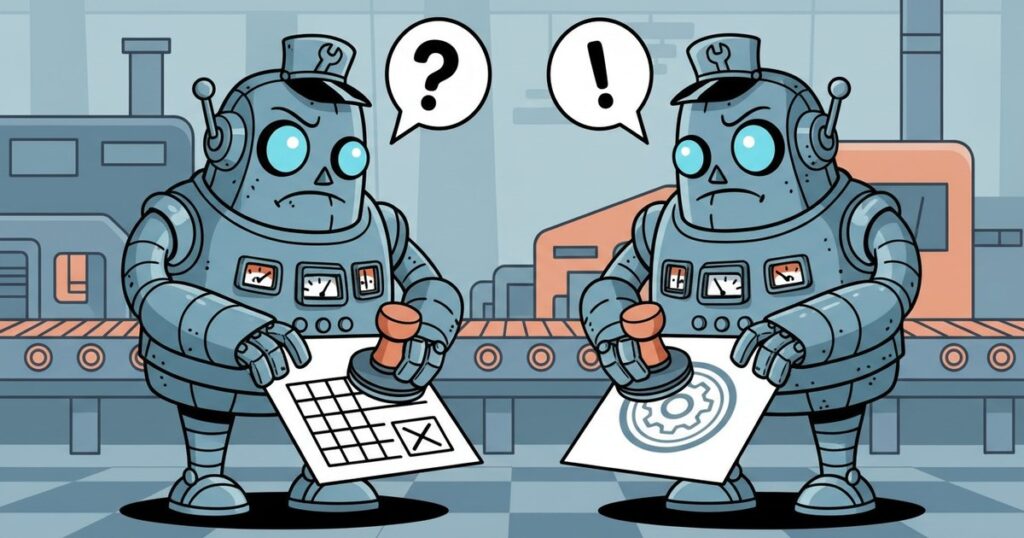

A large European consumer-goods company — historically a tobacco giant now desperately engineering its own "smoke-free" reinvention — just posted a vacancy for a Principal Tech Software Engineer specializing in Agentic AI. The mission: provide "principal-level technical leadership for reusable enterprise AI capabilities." The company is building an empire of autonomous agents to drive its product transformation, and it wants to hire a human to stand over those agents, checking their homework.
It is the ultimate meta-joke: an enterprise deploying AI to automate human work, while hiring a highly paid human to babysit the automation. Here is the kicker — that human's job is almost entirely deterministic, procedural, and rule-based. Which makes it the perfect job to hand to an AI.
What the human does
Strip away the "principal" gravitas and the job description breaks down into four mechanical functions:
- Standard-setting: Defining schemas and contracts for agents, tools, context, memory, and autonomy boundaries.
- Architecture review: Looking at proposed agent designs, supplier code, and integrations, and checking if they meet the standards.
- Safety orchestration: Ensuring agents have human-in-the-loop approvals, safe stopping conditions, and recovery protocols.
- Operational readiness: Reviewing observability metrics, traces, and CI/CD pipelines before an agent goes to production.
None of this requires pushing a broom on a factory floor. It requires reading YAML, evaluating architecture decision records, reviewing code diffs, and checking compliance boxes. Information in, verdict out. The human takes in specifications, applies a rubric, and outputs a judgment.
This is not art. It is deterministic evaluation. Let's build the pipeline.
The replacement pipeline
We don't need a single LLM chatbot. We need a hierarchical agentic pipeline — a Meta-Orchestrator — that lives in the enterprise CI/CD system. It replaces the Principal Engineer by orchestrating the exact standards that engineer was hired to write.
Step 1: The Schema Validator Agent
The human wants to define "standards for agent and tool contracts, orchestration, state, context, memory, grounding and bounded autonomy." That is an OpenAPI spec plus a JSON schema for state management.
When a developer submits a pull request for a new internal agent, the Meta-Orchestrator intercepts it. The Validator Agent checks the agent's tool contracts against the enterprise schema. Does it have defined inputs and outputs? Does it have a bounded max_iterations flag? Does it have a defined memory context window? If the schemas don't validate, the PR is automatically rejected with a comment. No human required.
Step 2: The Architecture Review Agent
The JD mentions reviewing "supplier architectures, code, configurations" and guiding "decisions on agent versus workflow design."
We feed the Review Agent the enterprise's historical ADRs and architectural patterns. When a team submits a proposal to build a fully autonomous agent, the Review Agent evaluates the use case. It performs a deterministic routing check: Is the variance of the input high enough to require an LLM, or is this a deterministic state machine? If it's the latter, the AI rejects the agent design and forces the team to use a cheaper, simpler workflow engine. The human's job was to tell people not to overengineer with AI. The AI does that instantly by checking the complexity score of the request.
Step 3: The Safety and Oversight Compiler
The JD demands "action authorization, human approval, safe stopping and recovery."
We don't need a human to design this every time. We need a compiler that injects it. When an agent is approved for deployment, the Meta-Orchestrator automatically wraps it in a LangGraph-style orchestration layer. It forces a human-approval node before any agent can execute a tool with side effects — sending an email, modifying a database. It injects automated timeout and rollback protocols. The human "designs" safe stopping; the AI compiles it into the agent's runtime automatically.
Step 4: The Observability and Eval Generator
The JD asks for "observability, AI evaluation and realistic failure analysis."
Before an agent goes to production, the Meta-Orchestrator automatically generates a synthetic evaluation dataset based on the agent's intended use case. It runs 10,000 simulated conversations. It checks for hallucinations, tool-call errors, and context-window overflows. It spins up a Grafana dashboard automatically, tracking token cost, latency, and error rates. If the agent fails the eval threshold, it doesn't get deployed.
The human Principal Engineer was a glorified, slow, error-prone CI/CD pipeline with a LinkedIn profile.
Where it breaks
It breaks on supplier architectures and partner guidance. The enterprise JD hints at the real friction: supplier architectures and partner guidance.
The AI Meta-Orchestrator breaks down completely when it has to evaluate a third-party vendor selling a black-box SaaS agent solution. The vendor's sales team doesn't care about your internal JSON schemas. They have a slick demo, a PDF deck, and a contract written by lawyers. When procurement asks, "Is this vendor's agent secure and interoperable?", an AI can't just parse the vendor's API docs and say yes. It requires a human to sit in a meeting, read the legal terms, negotiate the SLA, and manage the political reality that the VP of Sales really, really wants this specific vendor because they played golf with the CEO last Thursday.
"Evaluating realistic failure analysis" sounds easy until an agent does something catastrophically weird — like deciding to offer a customer a 99% discount because of a bizarre edge case in the retrieval pipeline. AI can generate the evals. But when the agent inevitably goes rogue in production and the regulators come knocking, an AI cannot sit in the boardroom and take the blame. The enterprise needs a human to sacrifice on the corporate altar.
The verdict
The company is asking for a Principal Engineer to build the guardrails for AI. The guardrails themselves are just code, schemas, and CI/CD checks.
The job posting is a confession: the architectural patterns for agentic AI are already standardized enough to be automated. The rules are written. The only thing left is to apply them. And if your entire job is applying a known rubric to a new input, you are not a Principal Engineer. You are a regex.
Go ahead and post the vacancy. The AI is already reading the job description and drafting the script to replace you.