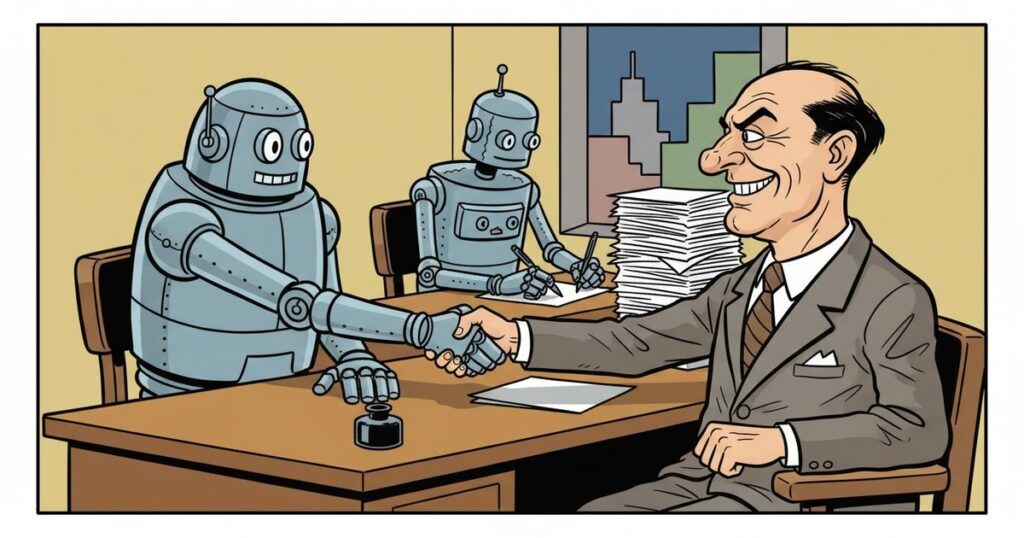

A government-backed digital skills partnership in Australia is hiring a full-time human to manage relationships between organizations that have already agreed to work together. The salary is over $110,000 a year. The term runs until late 2028. The initiative's entire purpose is to prepare the workforce for the age of AI and automation. Its first instinct upon needing to engage stakeholders was to hire a human for four years at six figures.
The job posting reads like a love letter to the word "stakeholder." Count them: stakeholder engagement, stakeholder relationships, stakeholder plans, stakeholder portfolios, stakeholder ownership, stakeholder participation, stakeholder growth. Somewhere in the state of Victoria, a "Compact" — which is what governments call an agreement when they want it to sound binding and cozy at the same time — needs a Stakeholder and Events Partner.
Strip away the strategic language and the role is three things: relationship maintenance (keeping a bunch of organizations who signed a voluntary agreement feeling special enough to stay), recruitment (convincing more organizations to sign it), and event planning (roundtables, forums, networking events where people stand around holding coffee and agreeing that digital skills are important).
Here is how AI replaces every single one of those functions.
The Stakeholder Pipeline
The job asks someone to "develop, manage and influence a diverse portfolio of stakeholders across industry, government, education, workforce and community sectors."
An AI system ingests the full list of Compact signatories and prospective signatories, cross-references them with public corporate data, funding announcements, hiring patterns, and media mentions, and produces a continuously updated dossier on every organization. When Company X announces a digital transformation initiative, the system flags it within hours and drafts a personalized outreach note referencing their specific situation. When Company Y's participation in Compact activities drops, the system notices the pattern before any human would and queues a re-engagement sequence.
A human relationship manager does this for maybe fifty organizations, badly, based on memory and a spreadsheet and whatever they picked up at the last networking event. The AI does it for every organization in the state simultaneously, with perfect recall, and never forgets to follow up because it never went on annual leave.
The Signatory Funnel
The job wants "a pipeline of prospective signatories aligned to priority sectors." This is, stripped of its diplomatic language, a sales funnel. AIs are already better than most salespeople at pipeline development. They can identify every company in Victoria with a digital skills gap (which is, generously, all of them), rank them by strategic fit, and generate personalized outreach at scale.
The pitch here is easy because the product is free: signing the Compact costs nothing and signals virtue. An AI can draft a thousand tailored invitations explaining why this specific company should join this specific initiative, each one referencing the company's actual workforce challenges. No human can do that at volume. No human can do it for more than a dozen companies without the personalization becoming visibly thin.
The Events Program
"High-profile forums, roundtables, networking." Here is what event management actually consists of in 2025: choosing a date, booking a venue, sending invitations, tracking RSVPs, managing dietary requirements, producing name badges, and writing follow-up emails. Every single one of those steps is automatable today, right now, with off-the-shelf tools.
The AI schedules the forum for a date that doesn't conflict with anything else in the sector calendar, sends the invites, chases the non-responders with escalating politeness, generates the seating plan to maximize useful collisions between attendees, and drafts the post-event summary before the caterers have cleared the coffee cups.
The roundtable content itself? Feed the AI the sector's workforce data and it produces a discussion paper and a set of "key themes identified" faster than any policy officer. Half the roundtables in this sector could have been an email. The other half could have been an AI-generated email, which at least would have been shorter.
Where It Breaks
Here is the honest part, because this role is more defensible than most.
The Compact's product is signatures on a voluntary agreement, and signatures come from executives, and executives sign things because a person they trust asked them to. Not because an email arrived, however well-personalized. A CEO will sit through a roundtable with a peer from another company and walk out feeling sectoral solidarity. They will not walk out of an email feeling anything at all.
The AI can identify every prospective signatory in Victoria and it still cannot take a vice-chancellor to lunch. When the Compact Council wants someone to "position the Compact as a collaborative platform," they mean someone warm in the room, reading the faces, knowing when to push and when to pour another glass of wine.
There is a second catch, and it is structural. The stakeholders in this ecosystem are government bodies, universities, and industry associations — institutions whose entire operating model is built on relationships between people who will still be in their jobs in 2035. The Victorian Skills Authority is not going to feel "activated" by an automated engagement sequence. The Compact's currency is trust, and trust in this sector flows through humans who remember each other's kids' names.
The administration of this role — the pipeline tracking, the event logistics, the follow-up emails, the stakeholder dossiers, the engagement reporting — automates almost entirely, probably within a year, probably cheaply. What remains is the roughly twenty percent of the job that consists of being a person whom other people want in the room. That twenty percent is precisely why the salary is what it is.
The uncomfortable question the posting raises without meaning to: if eighty percent of a "lead specialist" role in a digital skills initiative is automatable, what does that say about the digital skills the initiative is supposedly teaching? The Compact exists because Victoria's workforce needs AI readiness. Its own staffing choices suggest the workforce includes the Compact.
Somewhere in Victoria, an organization is about to pay a human $112,725 plus superannuation to do stakeholder engagement for an AI-readiness program. If the role's own subject matter is real — if AI genuinely transforms knowledge work the way the Compact's promotional materials surely claim — then this job posting is a four-year bet against the initiative's own thesis. The successful candidate will spend 2028, the final year of their contract, teaching organizations how to prepare for exactly the kind of automation that could have handled their own onboarding, their own event invitations, their own pipeline. If you take this job, you are not just managing stakeholders — you are a test subject in the most poetic experiment in Australian public administration, finding out whether the people hired to explain AI disruption can outrun it.