
A large European pharmaceutical manufacturing company is hiring a Senior AI Engineer in Prague. The role: design and deliver production-grade generative and agentic AI solutions that accelerate biomedical research, build secure RAG, and turn emerging agentic capabilities into reliable tools for scientists. Which raises a question nobody at the hiring table seems to have asked: once all that is built, what exactly is left for a Senior AI Engineer to do?
What the role actually does
Strip away the mission language and here's the job: take a vague scientific need ("we want to identify drug targets faster" / "we want to automate this assay review"), translate it into a software architecture, build LLM applications on a major cloud platform, wire up RAG pipelines, deploy agents, and keep them running in a regulated environment where security and compliance are non-negotiable.
That's a real job. It's also a job whose core deliverables — pipelines, agents, retrieval systems — are the exact artifacts that agentic AI is getting very good at producing.
What automates first: the RAG layer
The job description spends real words on RAG: hybrid search, embeddings, reranking, metadata, enterprise knowledge sources. Six months ago, building a production RAG system meant choosing an embedding model, standing up a vector store, wiring hybrid search, tuning reranking, managing chunking strategy, handling metadata filtering, and then debugging the whole thing for three weeks because the retriever kept surfacing the wrong paragraphs.
Today, a well-structured agent can scaffold that entire pipeline. You describe your document corpus, your access patterns, your security boundaries, and it generates the ingestion code, the retrieval logic, the reranking configuration, and the test harness. The human's job narrows to reviewing the architecture decisions, validating the security model against compliance requirements, and signing off.
The part that's genuinely hard — understanding which documents matter, how scientists query them, what "good retrieval" means in a biomedical context — is domain knowledge. And that domain knowledge lives with the scientists, not the AI engineer.
What automates next: the agents themselves
The posting mentions a managed agent runtime, an open-source agent framework, LangGraph, LangChain. These are frameworks for building agentic systems. The Senior AI Engineer's job is to use them to build agents that automate research workflows.
Here's the recursion: an agent built with LangGraph to automate a research workflow is a directed graph of LLM calls with tool bindings, state management, and error handling. A sufficiently capable LLM with code-generation ability can produce that graph from a natural-language description of the workflow. The "design" part — deciding which nodes exist, what each one does, how they connect — is increasingly something the model proposes and the engineer reviews.
Example:
- A scientist describes a workflow in plain language: "I want an agent that takes a target protein, searches internal assay data and external literature, proposes candidate molecules, and flags ones that match our safety criteria."
- A code-generating model produces a LangGraph definition: nodes for literature search, internal data retrieval, molecule scoring, safety filtering. Tool bindings for the company's actual APIs. State schema for passing results between nodes.
- The engineer reviews the graph, corrects edge cases the model missed (regulatory constraints, data access boundaries, that one API that returns 503 on Tuesdays), and deploys.
The engineer is now a reviewer. The building is automated by the thing they're building.
The lab-in-the-loop piece
This is where it gets interesting. The JD calls for "lab-in-the-loop systems where AI supports experiment design, interpretation of results and the next iteration of research." The role is to build AI that sits between the scientist and the wet lab, proposing experiments, reading results, suggesting next steps.
The automation play here is that the AI engineer builds the system, then the system narrows the engineer's involvement to maintenance. Once the loop is running — experiment design agent, results interpretation agent, next-iteration agent — the engineer's ongoing work is monitoring, debugging, and adapting the system when the underlying models upgrade or the scientific workflow changes.
That's not nothing. But it's also not a full-time job for a senior engineer. It's a few hours a week of oversight on a system that runs itself.
Where it breaks
Here is what does not automate cleanly: the translation layer between "ambiguous scientific problem" and "focused engineering execution." The JD calls this out explicitly, and it's the one sentence in the posting that describes something genuinely hard to automate.
A scientist says: "We need better target identification." The engineer has to figure out what that means in practice — which data sources, which models, which latency budget, which failure modes are acceptable, which regulatory boxes get checked, which of the seventeen things the scientist said actually matters. That decomposition is the real skill. It requires sitting in meetings, reading the room, understanding the political economy of a research org, and making judgment calls with incomplete information.
An LLM can do this badly. It can produce a plausible-looking plan from a vague prompt. The plan will be correct in shape and wrong in substance — the right nodes, the wrong constraints, a security model that looks fine until someone in compliance reads it and asks why patient-derived data is flowing through a non-validated pipeline.
That gap — between plausible and correct, between architecturally sound and regulatorily defensible — is where the human clings on. For now.
The verdict
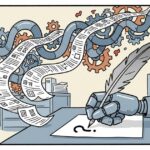
The company is hiring someone to build the system that makes their own role lighter. Every generation of engineers automates away part of the previous generation's work. But this posting is special because the thing being automated — agentic AI pipelines — is the same category of artifact that agentic AI is best at producing. It's a snake eating its own tail, and the tail is a LangGraph definition.
The Senior AI Engineer will build the agents. The agents will then help build the next set of agents. Each iteration, the human's contribution shrinks from author to reviewer to approver to the person whose name is on the incident report when something goes wrong in production.
If you take that job, build fast. The window between "you built the tool" and "the tool builds itself" is closing, and your employer just posted the job ad that proves it.