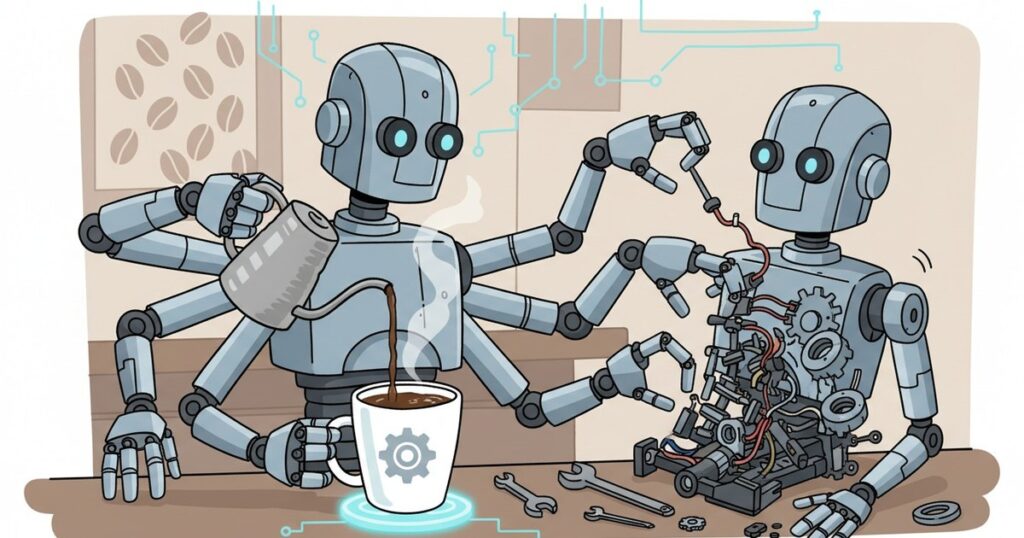

An IT services company in the European Union is hiring an entry-level AI Engineer. The pitch is almost touching: come build generative AI from PoC to scalable production for enterprise clients. They want someone fluent in the local language and English, comfortable with LangChain, model-routing services, RAG architectures, vector databases, agent frameworks, model evaluation, MLOps, and cloud deployment across three major providers. For an entry-level seat, that is a remarkably specific wish list — and also a remarkably automatable one.
Here is the quiet admission hidden in the posting: the role they are describing is a pipeline. Not a research position, not a novel-architecture shop, not a lab pushing model frontiers. It is an integration job. Take a client's domain, point an LLM at it, wrap it in retrieval, wire it to their stack, ship it. That is a factory floor, and factory floors are where machines move in first.
What the role actually does
Strip away the consulting romance and the day-to-day is this: a client shows up with a pile of documents or a data API and a vague desire to "use AI." The engineer builds a RAG pipeline — chunk the documents, embed them, store vectors, retrieve at query time, stuff them into a prompt, send it to a model, format the output, expose it as an endpoint. Maybe they add an agent layer for multi-step reasoning. Maybe they wire up evals to measure answer quality. They deploy it on a cloud provider, containerize it, write some infrastructure-as-code, hand it over, move to the next client.
That is not one job. That is a recipe. And recipes are exactly what language models are good at following.
How AI eats this role, piece by piece
The first thing to automate is the scoping conversation. A client says "we want AI for our support tickets." An AI system — not the one being built, a separate one — ingests that request, asks five clarifying questions, maps the client's data sources, drafts a proposed architecture, and produces a starter RAG pipeline scaffolded in Python before the human engineer has finished their coffee. The entry-level engineer's job of translating vague client wishes into a technical plan is a translation task. Translation is done.
Then the pipeline itself. The stack mentioned in the posting — LangChain for orchestration, a vector store for retrieval, a model-routing layer for model selection, an agent framework for tool use — is not a set of creative decisions. It is a wiring diagram. An AI coding agent can generate the entire scaffold from a natural-language spec: here is the data source, here is the embedding model, here is the chunking strategy, here is the retrieval top-k, here is the prompt template, here is the output schema. The human currently doing this makes choices from a menu, and menus are enumerable.
Model evaluation — the "evals" the posting mentions — is itself automatable. You define a set of test queries, a set of expected behaviors, a set of grading rubrics. An LLM-as-judge scores the outputs. The engineer's job is to design the rubric and read the scores. But rubric design for standard RAG use cases is converging on a template: relevance, faithfulness, context precision, answer correctness. The templates already exist in open-source eval frameworks. The human judgment layer is thinning.
Deployment: Dockerfile, cloud config, IaC. This is the part that is already most automated. Infrastructure-as-code generation from a spec is a solved problem for standard architectures. A RAG service behind a load balancer with a vector store and a model API is a standard architecture.
The pipeline that replaces the pipeline builder
Every component of the automated version exists today:
A client-facing intake agent collects requirements through a structured conversation. A planning agent decomposes the requirements into a pipeline spec: data connectors, chunking strategy, embedding model, vector store, retrieval parameters, model selection, prompt chain, output format, eval suite. A code-generation agent produces the repository: the ingestion scripts, the embedding pipeline, the vector store initialization, the retrieval logic, the prompt templates, the API layer, the Dockerfile, the cloud deployment manifests. An eval agent runs the test suite, scores the outputs, iterates on prompt templates and retrieval parameters until scores clear a threshold. A deployment agent ships it.
The human engineer in this picture is the person who reviews the plan, approves the deployment, and handles the edge cases the eval suite does not cover. That is not nothing. But it is a gatekeeping role, not a building role. And gatekeeping roles have a way of disappearing once confidence in the automated path grows.
The consulting firm's value proposition — fun projects, direct client impact, zero maintenance — actually accelerates the replacement. They are explicitly optimizing for greenfield builds over sustained ownership. Greenfield builds are the most templatable work in software. You start fresh, you follow a pattern, you ship, you leave. There is no accumulated context, no domain-specific institutional knowledge, no legacy system only one person understands. There is just the pipeline, and the pipeline is a pattern.
Where it breaks
The automation stumbles in three places.
Client data is messy in ways that resist templating. A client's document corpus has broken PDFs, inconsistent metadata, duplicate records, contradictory policy documents, a shared drive structure designed by someone who hated their colleagues. The ingestion and chunking strategy that works for one client's clean knowledge base fails spectacularly for another's disaster zone. An AI agent can attempt to clean and normalize, but the judgment call about what to keep, what to merge, what to flag for human review — that still requires someone who understands the client's domain well enough to know what "clean" means. The entry-level engineer does not have that understanding. They rely on the client to provide it. And the client is usually wrong about their own data.
Agent frameworks are not as composable as the posting implies. Multi-step reasoning with tool use sounds clean in a job description. In production it is a tangle of failure modes: the agent loops, the agent calls a tool with malformed arguments, the agent confidently fabricates a tool that does not exist, the agent gets stuck in a reasoning loop that burns through API budget. Debugging agentic behavior is a genuinely hard problem that does not yet have a fully automated solution. It requires the kind of iterative, hypothesis-driven debugging that experienced engineers do instinctively and junior engineers do badly. The posting asks for three years of software experience and production AI exposure, which is the minimum threshold at which someone has seen enough failures to recognize the patterns. An AI system debugging another AI system's agentic loops is possible in principle but currently unreliable in practice.
The client conversation. The posting requires fluency in the local language and English, and that is not a checkbox. It is because the clients have specific regulatory environments, specific industry vocabularies, specific organizational politics, and they need someone who can sit across a table and translate "the model hallucinated your return policy" into something that does not destroy the relationship. That conversation — the trust-building, expectation-managing, scope-negotiating conversation — is the part that resists automation longest. Not because it is technically hard, but because it is socially hard, and clients hire consultants for the social contract as much as the technical output.
The verdict
The consulting firm is hiring an entry-level AI engineer to build pipelines that are themselves becoming auto-generatable, for clients whose use cases are converging on a handful of templates, using a stack that is increasingly a wiring job. The honest version of the posting would say: we need someone to assemble AI systems from components that are themselves becoming AI-assembled.
The irony is thick enough to spread on toast. The role is "AI Engineer." The thing that replaces the AI Engineer is AI. Not eventually — the scaffolding generation, the eval suite design, the deployment config, the prompt iteration are all automatable today with existing tools. What remains is the messy, human, client-facing edge work that the posting barely mentions because it does not sound impressive in a job ad.
If you take this job, learn the parts that are not in the posting. Learn the client conversation, the data archaeology, the agentic failure-mode debugging. Everything else — the LangChain, the vector stores, the evals, the cloud deployment — is the part the machine learns to do while you are still onboarding. Drink the coffee they promised over the application fast. The barista is also a model.