
A software development company serving the global energy utility sector is hiring a Product Owner for its Asset Performance Management suite. The job description is a masterpiece of corporate choreography: you will "translate portfolio direction into the EAM product roadmap," "collaborate with the Head of Product Management," and "ensure differentiation" for transmission and distribution system operators worldwide.
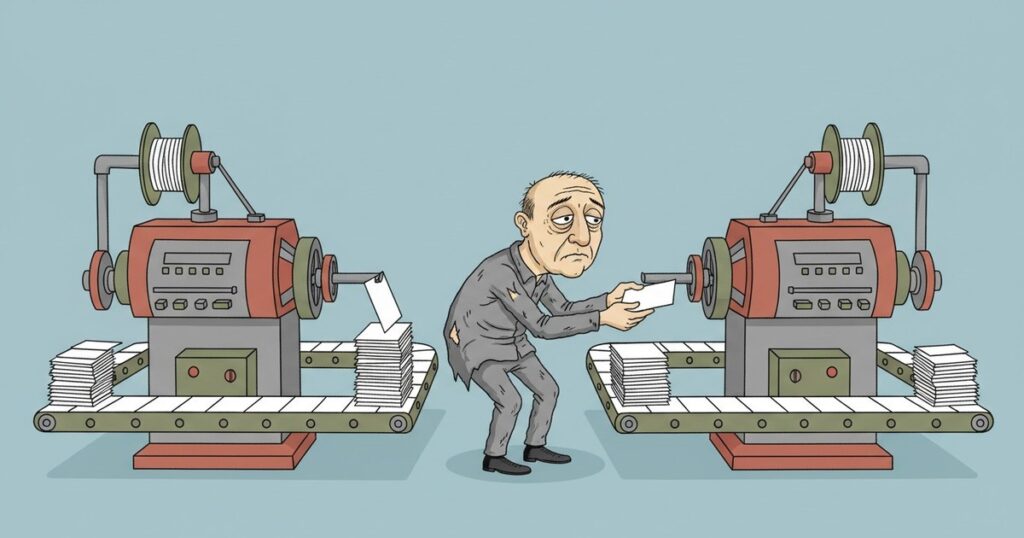
The Head of Product Management defines the market strategy. The engineering team writes the software. The Product Owner sits between them, translating. A biological middleware layer between "what we should build" and "the ticket that describes what we should build."
We have software for that.
What the role actually does
An APM Product Owner at an enterprise utility software company lives in a specific loop. The Head of Product says: "The market needs better predictive maintenance analytics for grid transformers." The Product Owner takes this, talks to a few large transmission system operators, reads the industry requirements, and decomposes that sentence into a backlog of Jira epics: "Implement sensor data ingestion API," "Build anomaly detection dashboard," "Create asset health score configuration."
They write user stories. They groom the backlog. They prioritize tickets for the sprint. They sit in planning ceremonies and answer the developers' questions about whether a "critical asset failure alert" should be sorted by asset type or by geographical region. They accept or reject the work at the end of the sprint.
The role is entirely defined by taking high-level intent, parsing it against domain knowledge, and producing structured, actionable specifications. It is about to be eaten by a pipeline that does exactly this, faster, and without needing a salary.
The automated Product Owner
You do not need artificial general intelligence to replace this specific human. You need a large context window and three prompts.
Step 1: The Strategy Intake
The Head of Product Management writes their quarterly strategy memo. This is already a document. You feed this memo into an LLM. The prompt is simple: "You are an expert Product Owner for enterprise Asset Performance Management software serving electrical power utilities. Decompose this strategic memo into a set of high-level epics. For each epic, identify the target user persona, the business value, and the technical dependencies." The model outputs five to ten epics. It will mention SCADA integration, IEC 61850 compliance, and predictive failure models because it has read every piece of APM documentation ever indexed on the internet. It will not need a "plus" of power utility experience. It already has it.
Step 2: The Backlog Generation
For each epic, you run a second prompt: "Decompose this epic into user stories in the standard format: 'As a [grid operator], I want [to ingest partial discharge sensor data] so that [I can identify failing cable terminations before outage].' Include acceptance criteria." The model generates the stories. It writes the edge cases. It specifies that the data ingestion API must handle asynchronous polling because some legacy RTUs only report hourly. The human Product Owner would have had to look this up or ask a senior engineer. The model just knows it.
Step 3: The Backlog Grooming and Prioritization
You maintain a vector database of every support ticket, feature request, and sales call transcript from the company's history. You embed the new epics and stories into this database. You ask the model: "Prioritize this backlog based on the frequency of related customer pain points in the support database and the revenue weight of the requesting clients." The model sorts the backlog. It pushes the transformer-health dashboard to the top because three tier-one grid operators complained about it last quarter. It pushes the "custom color palette for reports" feature to the bottom because nobody cares.
Step 4: The Sprint Ceremony
The developers need clarification on a story. Instead of booking a 30-minute call with a Product Owner, they query the system. The system has the full context of the strategy memo, the generated story, and the entire history of the product's codebase and documentation. It answers: "The alert should be sorted by geographical region because the utility's dispatch system routes repair crews by zone, not by asset class." The answer is instant. The answer is correct.
Where it breaks
This is not a flawless utopia. There is a catch, and it is the reason the office is still hiring humans today.
The system breaks at the political boundary. Enterprise software for utilities is not sold on features. It is sold on trust, long procurement cycles, and the quiet assurance that the vendor "understands our specific regulatory environment."
When a large transmission system operator in a specific European country demands a feature that makes no technical sense but is required by their local regulator, a human Product Owner nods, sighs, and writes the ticket. They understand that the customer is always right, even when the customer is a bureaucratic monolith with a 10-year contract.
An AI will look at the request, compare it to the global best-practice documentation it was trained on, and confidently explain why the feature is a bad idea. It will refuse to prioritize it. It will cite efficiency metrics. It will be completely, infuriatingly right, and it will lose the account.
The human Product Owner survives not because they are better at writing user stories. They survive because they are a social shock absorber. They absorb the irrational demands of large enterprise clients and translate them into rational, buildable software without ever telling the client they are being irrational. Diplomacy is still hard for software.
The real future of the role
The person who takes this job will spend their first six months writing user stories and grooming the backlog. Then someone at headquarters will read an article like this one, spin up a trial of the automated backlog generation pipeline, and realize the junior product owners are generating the exact same epics as the LLM.
The role will shrink. The "translation" part of the job will evaporate. What will remain is the part the job description does not explicitly mention: flying to visit a grid operator, drinking bad coffee in a conference room, and nodding politely while a senior engineer explains why their specific substation configuration requires a custom data model.
The AI will write the ticket. The human will drink the coffee. And the job posting will quietly change from "Product Owner" to "Customer Relationship Manager."
The company is hiring a translator. Translation is a solved problem. They just haven't realized it yet.