
The mantra "we absolutely need live experts to verify neural network results" sounds solid, reassuring, and completely suicidal for your business. It lands so pleasantly on the ears of a board of directors that nobody notices one detail: companies building their processes around this postulate are confidently buying a ticket to a deep economic abyss. With a beautiful justification, a twenty-slide presentation, and the approval of every senior engineer — straight into the abyss.
The economy doesn't care what you think of yourself
The economics of new technology are merciless, and right now they are breaking habitual corporate snobbery over their knee. The paradox of the current moment is this: the main drivers of the AI revolution are not tech giants with armies of senior engineers, but those who have no in-house expertise at all. Hungry, aggressive players who were previously locked out of expensive brains.
It's not about lacking experts. It's about what follows from that lack. These companies "without a background" are pouring real money into AI implementation — not checkbox pilots, but live production processes. For them, a neural network is not an intern whose every comma you check with a magnifying glass, and not an advanced autocomplete for a tired mid-level dev. It's the only way to survive, skip a rung, and scale. They simply don't have the expensive expertise to install as an overseer. And that turns out to be their advantage.
They cannot afford the luxury of manually verifying every sneeze. So they are forced to immediately build systems where AI works, tests, and deploys autonomously. They bruise their shins, crash production, take hits — but they are rapidly forming the new market norm while everyone else is in meetings.
What the owners of "human expertise" are doing
What are the ones with entire departments of fabled "human expertise" doing? They are stroking their egos.
Their highly paid specialists treat AI with condescension — like an old-school craftsman facing a CNC machine that "still needs to be double-checked by hand." And here lies the economic mine they can't see. The process of constant approval and verification kills the main advantage of neural networks: extreme speed and the zero cost of scaling a result. AI speed is artificially throttled down to the speed of the slowest verifying expert.
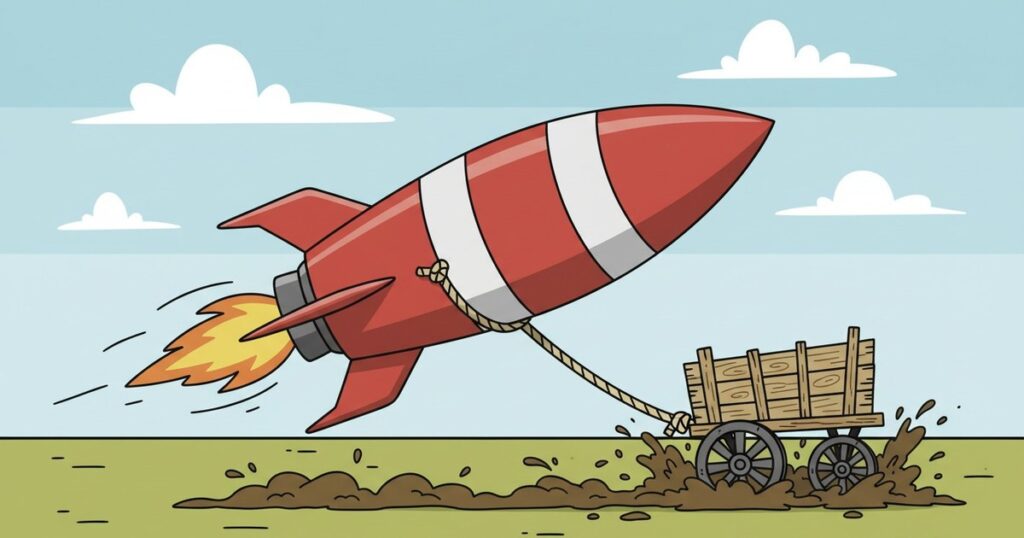
Think of this as a formula, not a slogan. For a neural network, the marginal cost of the next unit of work approaches zero: generating one report or a thousand costs almost the same. The moment you put a human with a red pen at the output, you take that zero and multiply it back by a senior's hourly rate. Zero scaling cost becomes linear — exactly the same as you had before any AI. You bought a rocket and tied it to a cart, because you understand the cart and the rocket is scary.
Quiet stagnation disguised as responsibility
As a result, such companies doom themselves to quiet, comfortable stagnation. On the outside, everything is decent: AI is "being implemented," budgets are being spent, checkboxes in reports. On the inside, nothing changes. They will never gain real, dirty practice in large-scale automation. The kind where you crash a system, clean up the mess, build the guardrails, and learn to trust the machine in production. They won't master the tool at the architecture level, because they will use it only as a crutch for familiar manual processes.
Worse, this approach generates a monstrous bus factor. A business confident that "human experts" are saving it becomes totally dependent on them. Remove that specialist from the chain and the process collapses. Not because the task can't be automated, but because the company never learned to delegate decision-making to algorithms. It learned only to delegate drafts to algorithms. The human still makes the decision, which means all the value remains locked inside the human. You thought you were building a process; you built a dependency on specific people who will get poached or burn out.
What actually scales
Now look at what scale looks like when manual verification of every step is physically impossible.
Releases that took months start shipping in weeks. Defects drop from five to ten a day to fewer than five a week — not because someone is catching them more carefully by hand, but because a system catches them: tests, pipelines, automated gates. Revenue grows by double digits year over year. This isn't the effect of an army of checkers — it's the effect of control living inside the system instead of being bolted on by a human at the exit.
When you have forty-plus services and twenty-plus teams in a pipeline handling hundreds of millions of dollars, you simply don't have the option to "put an expert to check every step." Either control lives in the architecture — in tests, invariants, automated checks — or it doesn't exist. Machine learning runs in production on hundreds of millions of profiles not because someone reviews every prediction, but because the system is designed to operate without a human overseer.
And the control shot into the whole postulate. The thesis "a human must verify the machine" is not a law of nature; it's an organizational habit. Verification itself is automatable: model-as-a-judge, where one model checks another's output against given criteria, is a working, battle-tested practice. "We must verify" does not mean "a human must verify." And by May 2026, more than eighty percent of the code in Anthropic's production codebase is authored by Claude. Autonomous authorship in production is no longer a bold experiment; it's the norm for those building the AI itself.
The winner runs faster
That's the whole point. The winner is not the one who perfectly insures against risks, but the one who runs faster and adapts to chaos. The market doesn't award a prize for the neatest job description. It awards it for speed and for the cost of scaling — and the verification layer kills both metrics first.
Those who throw AI onto the front lines today without a safety net in the form of a human overseer with a red pen will take this market. Not because they are braver, but because their economics work, and the cautious ones' economics don't. Bet on them, not on those trying to fit the future into the frame of their outdated job descriptions.
The system builder vs. the chair warmer
Conclusion, and it's not "fire all the experts." It's about where the expert stands in the system.
There are two fundamentally different positions. The first is the human overseer sitting at the end of the conveyor belt with a red pen, double-checking the machine. He is the bottleneck, he is the bus factor, he is the multiplier that turns zero scaling cost back into linear. The second is the architect who builds a system of people and agents and delegates the actual decision-making to algorithms, not just the drafts. She embeds control into the architecture: tests, invariants, automated judges, gates. And the first thing she does is remove herself from the verification chain — because she understands that any human on the critical path is the exact bus factor she is obligated to eliminate.
The difference between these two is the difference between a company that scales and a company that quietly stagnates with a full staff of very expensive, very respected people.
So the next time you hear the solid-sounding "we need live experts to verify neural networks," translate it into the language of economics. It means: "we are voluntarily slowing the machine down to the speed of our slowest employee, returning linear scaling costs to ourselves, and building a business that will collapse if we pull a couple of people out of it." You are either building a system that scales or a dependency that breaks — and if you plan to build the system, you already know exactly where to take yourself out of the critical path.