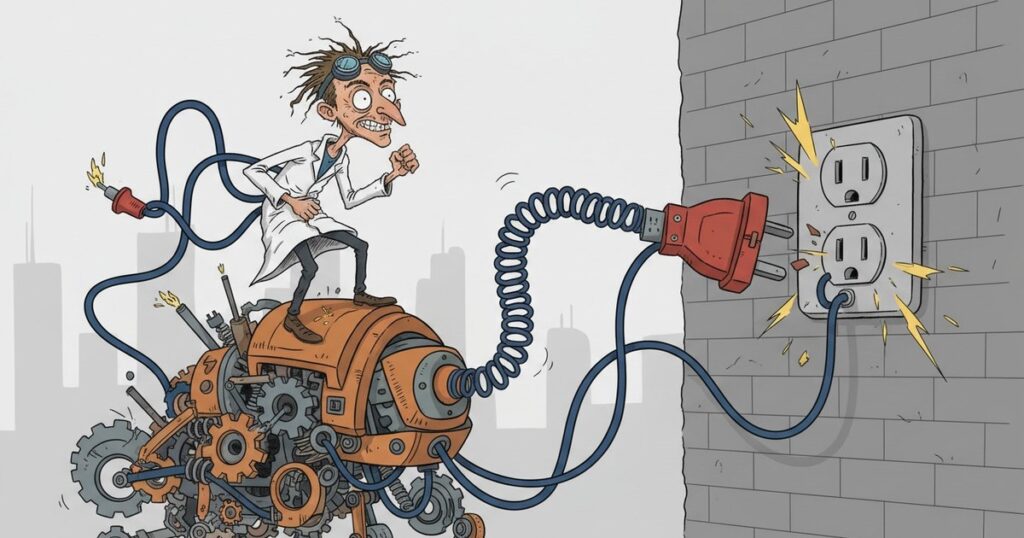

A European advertising company — the kind that builds campaigns for brands you'd recognize — just posted a vacancy for an "AI Ecosystem Architect." The job description is a love letter to possibility: Imagine it. Architect it. Make it scale. The candidate is asked to dream up systems that don't exist yet, translate a vague vision into a machine-readable "intelligence layer," and build the foundation for an entire ecosystem of AI agents that will eventually do the marketing themselves. That job is the first one AI eats.
What the role actually does
Strip away the poetry and the job is concrete. The hire will take a sprawling brand library — guidelines, documents, assets, institutional knowledge locked in people's heads — and turn it into a structured, machine-readable layer that other AI applications and agents can query. They'll design the architecture. They'll prototype concepts. They'll sit in rooms and say "what if we did this" and then build a demo that makes the idea obvious.
It's a translation job. Human brand knowledge goes in one end; structured, queryable, agent-ready intelligence comes out the other. Between those two endpoints sits a person who reads the brand book, looks at the assets, decides what structure the data should take, builds a prototype, shows it to stakeholders, and iterates until the thing works. That person is about to be a pipeline.
How AI replaces it
The replacement comes in layers, each of which already exists as a working tool.
Layer one: ingest the brand library. Feed every brand guideline PDF, every tone-of-voice document, every creative asset, every past campaign brief into a document processing pipeline. Use an embedding model to chunk and vectorize the lot. This is a weekend project. The "institutional knowledge locked in people's heads" part? Run interview transcripts with the senior creative team through a transcription service and embed those too. The brand library is now searchable, queryable, and ready to be structured.
Layer two: build the intelligence layer. This is the part the job description treats as craft requiring a visionary. In practice it's a schema design problem. You prompt a language model with the entire embedded corpus and ask it to propose an ontology: what are the entities in this brand, what are the relationships, what are the constraints, what's the tone matrix, what are the visual rules. The model proposes. You refine. It regenerates. After a few iterations — hours, not weeks — you have a structured brand representation that an agent can query. The "architect" didn't design it. They reviewed it.
Layer three: prototype the ecosystem. The posting says the hire will "develop concepts, system designs, and prototypes that make new possibilities visible." This is the part the company is most proud of, and it's the part AI does best. You give the model the intelligence layer and say: propose agent workflows that would improve how this brand's marketing team works. It proposes. You pick the most promising. You say: build a prototype of workflow three. It builds one — a working demo, with a front end, connected to the brand layer, running in an afternoon. The "what's possible today that wasn't possible yesterday" question is a prompt.
The pipeline, concretely
Here's what the automated version looks like, built from parts that exist right now:
A document ingestion pipeline pulls every brand asset from the company's storage — PDFs, slide decks, image libraries, style guides. A vision-language model tags images with brand attributes. A text model extracts tone rules, voice guidelines, messaging hierarchies, and forbidden phrases from the written documents. Everything gets embedded into a vector store.
Then a schema-generation pass runs: an LLM reviews the full corpus and proposes a brand ontology — entities, relationships, constraints, tone parameters. A second pass refines it against edge cases pulled from past campaign archives. The result is a structured brand representation sitting in a database, queryable by any agent that gets pointed at it.
Then the prototyping loop: an agent is given the brand layer and a goal — improve campaign briefing, automate tone-of-voice checking, generate on-brand first drafts. It proposes a workflow, builds a prototype, and demos it. The human reviews. The agent iterates. The human's role in this loop is taste.
The job posting says the hire will "not wait for someone to tell them what to build." Neither does the agent. You give it the brand layer and a broad objective and it generates candidate systems faster than any human can sketch them.
Where it breaks
The pipeline can't do politics. A marketing company's brand library isn't just a corpus — it's a battlefield. The creative director thinks the brand voice is one thing. The client lead thinks it's another. The legal team has opinions about what's "on brand" that nobody else agrees with. The intelligence layer needs to represent the negotiated brand — the one that survives all those stakeholders. A language model can extract the explicit rules. It cannot extract the implicit compromises, the things everyone knows but nobody wrote down, the campaign that was killed for reasons that were never documented.
The pipeline also can't do conviction. The job posting is right that someone has to look at a prototype and say this is the future, I will fight for this. A model can generate fifty candidate systems. It cannot decide which one is worth a career. The part where someone looks at a speculative demo and bets the department on it stays human, because the model doesn't have to live with the consequences.
And the pipeline can't do the last mile of trust. Stakeholders will look at a brand ontology generated by a model and ask who built this. When the answer is "a person who understands our craft," they sign off. When the answer is "a pipeline," they hesitate. That hesitation is the human's remaining job — being the face on the machine's work.
The verdict
The company posted a job that asks one person to imagine, architect, and scale an AI ecosystem for marketing. The ecosystem they want is the one that replaces the person they're hiring. The architect designs the system that makes the architect unnecessary. The intelligence layer they build becomes the thing that lets agents do the architecting next time.
The only question worth asking in that interview: what do you do on day two? Day one is building the machine. Day two is the machine not needing you.