
A Gulf-based airline — the kind with routes, loyalty tiers, and a perpetual grudge against jet fuel prices — posted a vacancy for a Senior Generative AI Engineer. Seven-plus years of experience. Cloud ML platform, Python, Spark, Agentic AI. Airline domain experience required. Must start immediately. The subtext is louder than the text: they have data, they have bought cloud credits, and they need someone to make the AI do the thing before the board asks why the AI has not done the thing.
Here is what this engineer actually does at an airline — and the pipeline that swallows the entire role.
What the human actually does
A Senior GenAI Engineer at an airline is not sitting in a lab chatting with a bot. Their daily diet is the exhaust of a global operation: ticketing transactions, no-show probabilities, fuel burn forecasts, crew rosters, baggage routing logs, pricing elasticity curves, and the chronic complaints of frequent flyers whose status tiers never quite translated into an upgrade.
The job description describes the honest version: ML pipelines on a major cloud ML platform, training to deployment to monitoring, feature engineering on large-scale datasets, Spark in batch and real-time. This is someone who takes a chaotic stack of historical booking data and real-time operational feeds, cleans it, turns it into features, trains models, serves them, and keeps them alive in production without the whole thing collapsing the first time someone sneezes near the pricing engine.
The GenAI and Agentic AI labels on the JD are current fashion. They signal that the airline wants to use large language models for something beyond autocomplete — intelligent customer service agents, operations copilots for dispatchers, automated resolution of refund requests, a chatbot that can actually rebook a passenger when a connection dies instead of apologizing with a warm tone while doing nothing.
How AI eats this job
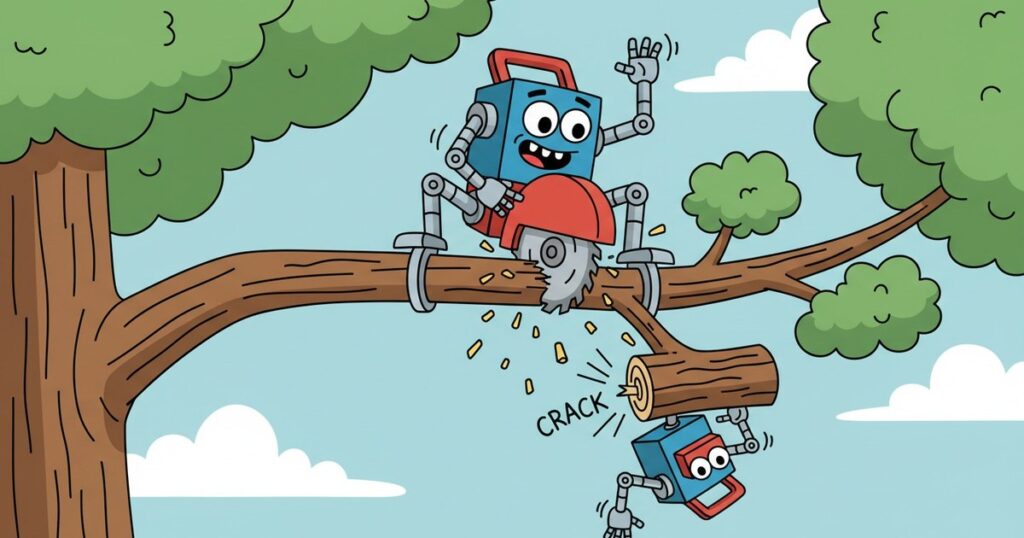
A GenAI Engineer builds AI for a living. This makes the role the most exposed to being done by AI. The engineer is building the saw that cuts their own branch, and the cutting has started.
Phase 1: The pipeline work
Most of this role is pipeline construction. Data ingestion, feature engineering, model training loops, deployment configs, monitoring dashboards. The engineer writes Python glue code and notebook files, connects Spark jobs to cloud object storage, configures data factory pipelines, and prays the orchestration does not break at 3 AM.
This part is being eaten right now. An AI coding agent — the kind that already exists — can scaffold an entire cloud ML pipeline from a natural language spec. "Read the booking data from object storage, aggregate daily load factors by route, join with weather data, train a gradient-boosted model on no-show probability, register it in the model registry, and deploy it as a batch scoring job." That is a prompt. The agent writes the notebooks, configures the Spark clusters, handles the CI/CD pipeline, and sets up the monitoring. The engineer becomes the reviewer. And the review is becoming a ritual.
The feature engineering — staring at raw data and deciding that days_until_departure and historical_no_show_rate_by_route are useful — is also being automated. Feature stores exist. AutoML exists. An LLM that has ingested the schema of the airline's data warehouse can propose features faster than a human can type them. Airline domain knowledge helps, but an LLM has read every public paper on airline revenue management and no-show prediction ever published. It has more domain breadth than any single engineer.
Phase 2: The model work
Training models sounds sacred. It is not. For the vast majority of airline ML use cases — demand forecasting, no-show prediction, delay estimation, churn modeling — the models are standard. XGBoost. LightGBM. Sometimes a neural network for sequence data. Sometimes an LLM for text classification. The features differ, the hyperparameters differ, but the architecture is known.
Automated model selection and hyperparameter tuning already outperform most human engineers on standard tasks. Major cloud ML platforms ship AutoML out of the box. The engineer's job shifts from "design the model" to "select the AutoML config and interpret the results." That is a thinner role. A good AI assistant handles it while the human gets coffee.
Phase 3: The GenAI and Agentic layer
This is where the role gets the GenAI label, and where it gets most automatable. Building an LLM-based agent for airline operations means defining the tools the agent can call, the prompts that govern its behavior, the guardrails that keep it from rebooking passengers onto competing carriers, and the evaluation harness that tests it before deployment.
This work is heavily text-based. System prompts, tool schemas, evaluation datasets, guardrail rules. It is the exact format an AI coding agent excels at generating. You describe the desired agent behavior in plain English, and the AI produces the tool definitions, the prompt templates, the framework scaffolding, the evaluation scripts. The human reviews. The human tweaks. The human does not write the first draft anymore.
Phase 4: MLOps and production
The JD demands MLOps: CI/CD, automation, observability. This is infrastructure code. Infrastructure-as-code templates, cloud resource definitions, job definitions, CI workflow configs — an AI agent generates these reliably from specs. The engineer's architectural judgment still matters. The typing is gone.
Where it breaks — the catch
Here is what does not automate cleanly.
Airline politics. A model that predicts no-show rates might suggest overbooking more aggressively. The commercial team loves this. The operations team hates it because airport meltdowns are expensive and public. The engineer is not just building a model. They are mediating between teams with opposing incentives. An AI cannot attend a stakeholder meeting, read the room, and realize that the CFO's enthusiasm for the new pricing model is going to get the Head of Operations fired in October.
Regulatory and safety constraints. Airlines are regulated. Models that touch pricing, passenger treatment, or operational decisions may require documentation, auditability, and sign-off. An AI can generate the model card. It cannot sit in a compliance review and defend the choice of features to a regulator who does not understand gradient boosting but does understand discrimination.
The first week of a new data source. When the airline ingests a new feed — real-time weather data from a new provider — the schema is messy, the semantics are unclear, and someone has to sit with the source team and figure out what the fields actually mean. An LLM can guess. It will often be wrong in ways that are silent and expensive. Domain intuition catches this. Automation propagates it.
Edge cases in production. A model starts drifting. The monitoring dashboard goes yellow. The AI can detect the drift. Diagnosing why — a change in booking behavior due to a competitor's flash sale, a data pipeline dropping records, a calendar anomaly — requires investigation that blends data engineering, business context, and operational reality. This is where the senior engineer earns the "senior" label. AI assistants help here. They do not replace.
The verdict
The pipeline work automates first. The model work automates next. The GenAI agent scaffolding automates alongside. What remains is human judgment, stakeholder mediation, regulatory defense, and the first messy week of any new data source.
That remaining core is real. It is maybe 20% of the current role. The other 80% is the kind of work that an AI coding agent — the very thing this engineer is hired to build — does faster, cheaper, and with fewer notebooks that nobody ever reads again.
The airline wants seven years of experience. They need someone who remembers what it was like before the tools could write themselves, because that institutional memory is the only thing standing between a deployed model and a quiet disaster.
The job posting is the confession. The start date is urgent because the window is closing. Post the vacancy — and watch the vacancy post itself.