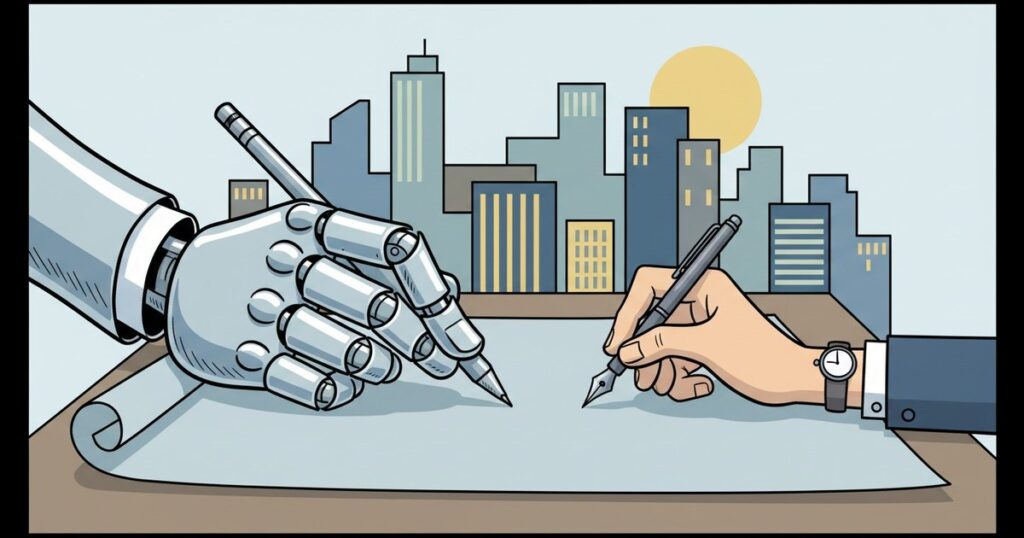

A large European telecommunications company — the kind that wins government contracts by the kilometer — has posted a vacancy for an "AI Solution Architect" in the public healthcare sector. The job is remote. The title is in German. The responsibilities are in German. The irony is universal.
The gist: this person sits between the people who run hospitals and the people who write code. They take vague requests like "make the patient intake smarter" and produce a coherent technical architecture document describing which microservices talk to which APIs, where the data lives, how it's secured, and which generative AI components bolt onto which legacy system. Then they defend those decisions in meetings, coordinate with six different teams, and technically lead the developers who actually build the thing.
It pays well. It requires judgment, experience, and the ability to hold a room full of stakeholders who all want different things. And it is, almost in its entirety, a job that AI can now do.
Let's walk through it.
What the role actually does
An AI Solution Architect in healthcare spends roughly 70% of their time producing documents and 30% in conversations that exist to validate those documents. The documents take specific forms: architecture decision records, integration patterns, non-functional requirements specs, technology selection matrices, risk registers, and the all-powerful "solution blueprint" — a diagram-heavy artifact that tells everyone what to build before anyone builds it.
The conversations follow a loop: a product owner describes a need, the architect translates it into constraints, the architect drafts a design, the design gets reviewed by security, infra, and QA, the architect revises, presents to a steering committee, defends choices, and revises again. The cycle repeats until everyone is tired enough to approve something.
The actual creative work — the part that requires a senior human — is narrow. It means deciding between genuinely competing approaches when the trade-offs are unclear, understanding the political landscape of a public healthcare client well enough to know which technically-correct solution will be rejected for organizational reasons, and catching the one integration edge case that nobody else in the room would have noticed.
Everything else is pattern-matching against architectures the industry has already standardized.
How AI eats this role, piece by piece
The design pipeline
A modern AI Solution Architect's workflow is already a prompt chain waiting to happen. Here is the pipeline that replaces the drafting portion of the job:
Step 1: Requirements ingestion. A meeting transcript or a Jira epic gets fed to a model with a system prompt that extracts structured requirements: functional, non-functional, regulatory (GDPR in healthcare — always), and integration constraints. The model outputs a requirements spec in a standard template. A human reviews it in ten minutes instead of spending two days writing it.
Step 2: Architecture generation. The requirements spec goes into a second prompt — or more precisely, into a model fine-tuned on the company's own architecture repository, which is full of previous solution blueprints for similar healthcare clients. The model produces a draft architecture: microservice boundaries, API contracts, event flows, data store choices, deployment topology. The job description literally lists cloud, on-prem, and hybrid because the answer is always "it depends." The model references the company's existing reference architectures because it was trained on them.
Step 3: Technology selection. The model produces a comparison matrix of candidate technologies — containers, messaging systems, orchestration tools, LLM frameworks — scored against the non-functional requirements. This is the part where a human architect currently spends a week reading documentation and benchmarking. The model reads documentation faster.
Step 4: Risk and dependency analysis. A separate pass over the architecture identifies integration risks, security dependencies, data residency issues, and the inevitable "this legacy system only supports SOAP" problem that haunts every public-sector healthcare project in Europe.
Step 5: Architecture documentation. The model generates the ADRs, the blueprint diagrams via a diagramming tool's API, and the slide deck for the steering committee. The human who currently does this by hand in Confluence and PowerPoint can go home.
Designing the AI systems that replace the architect
The job description mentions integrating AI agents, retrieval-augmented generation, and other generative AI components into the solutions. This is the architect being asked to design AI systems. The joke writes itself: the architect is designing the thing that will replace the architect.
A RAG pipeline for healthcare data follows a known pattern: chunk clinical documents, embed them, store in a vector database, retrieve with metadata filters for patient context, ground the LLM's responses, log everything for audit. An AI agent orchestration layer follows a known pattern: define tools, define guardrails, route between models based on task type, add a human-in-the-loop approval step for anything that touches patient data. These are not open research questions. They are recipes. A model with access to the last two years of architecture blog posts and the company's internal wiki can produce a competent design for either one in minutes.
The coordination layer
The posting asks the architect to coordinate with development, infrastructure, security, integration, QA, and operations teams. Six teams. This sounds human, because it involves talking to people, and talking to people is the last thing we like to admit machines can do.
But what does this coordination actually look like? The architect posts a design document, each team reviews their section, each team raises objections, the architect reconciles objections, the architect updates the document. That is a workflow. An AI agent can draft the document, distribute it to the relevant teams' ticketing systems, collect review comments, categorize them as security concern, infra constraint, or QA feasibility, draft responses, and flag only the genuine conflicts for a human to resolve. The human in this loop is a decision-maker.
The technical leadership of development teams is the part where the architect answers questions from developers, reviews technical approaches, and unblocks decisions. A well-prompted model with access to the architecture documentation and the codebase can answer those questions in a Slack channel faster and more consistently than a human who is in three other meetings. The developers will not even mind. They already prefer asking the bot.
Where it breaks: the catch
Here is the honest part, because without it the rest is just a victory lap.
The role does not automate cleanly in three places.
First, public-sector procurement politics. A healthcare ministry does not choose a technology because it is the best technology. It chooses a technology because three vendors submitted bids, one is already a preferred supplier, one has a regional office in the right state, and one hired a consultant who plays golf with someone. No model navigates this. The architect who survives automation is the one who knows which technically-inferior option will win and designs for it without complaining.
Second, liability anchoring. Public healthcare systems require a human name on architecture decisions. Not because the human is better at making them — because someone has to be legally responsible when the integration fails and patient data ends up in the wrong database. The AI can draft the perfect ADR. A human still signs it. This is a governance problem, and it will outlast every model upgrade.
Third, the edge case nobody has seen before. A model trained on existing architectures produces existing architectures. When a healthcare client has a genuinely novel constraint — a legacy system with an undocumented API, a regulatory requirement that contradicts itself, a data-sharing agreement between two regions that was drafted before cloud computing existed — the model will produce a plausible-looking answer that is wrong in a way only an experienced human will catch. The cost of that wrongness, in healthcare, is not a bug report. It is a compliance incident.
So the role shrinks. It does not vanish. The architect becomes a reviewer, a signatory, and a political navigator — the person who reads the model's output, catches the 5% that is subtly wrong, and signs their name on the other 95% because the governance framework requires a name.
The verdict
A company that sells AI transformation to healthcare clients is hiring an AI Solution Architect. The job is to design AI systems. The job is itself an AI system waiting to be designed.
The posting asks for five-plus years of experience, leadership skills, communication skills, and a "holistic architecture vision." That vision, in 2026, looks like a prompt chain with a human at the signing step.
If you are the hiring manager reading this: the candidate you are looking for is already running on your infrastructure. It just needs a job title.