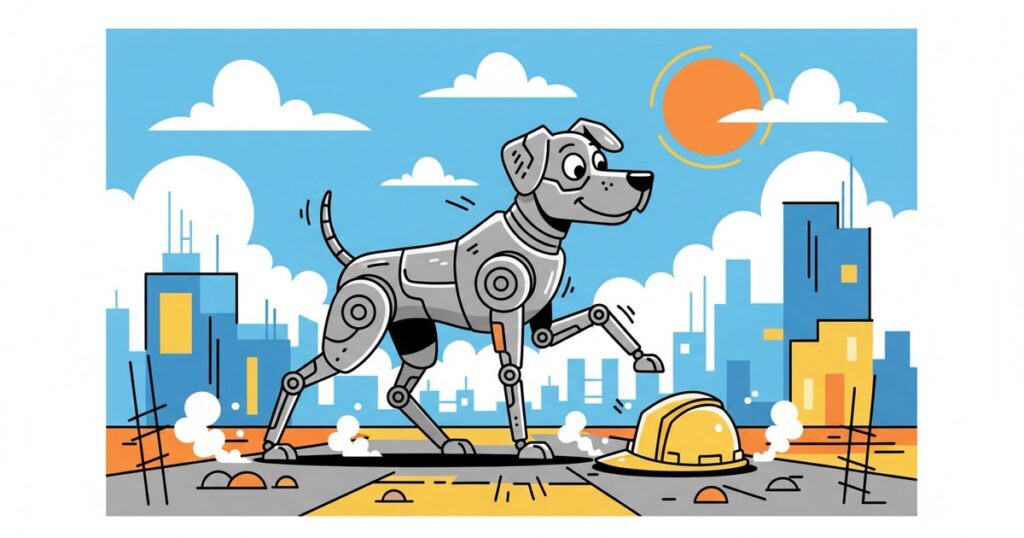

A large UAE construction company wants to become a "technology-enabled partner." So they're hiring a Head of Innovation & Technology — 15+ years of experience, a Master's degree, a department to build from scratch, and a flagship robotics initiative to lead toward a future of humanoid and quadruped robotic platforms doing repetitive, physically demanding work on construction sites. The core purpose of this role is identifying, evaluating, and integrating new technology. The very technology this role exists to procure is now consuming the role itself. The Head of Innovation is supposed to build the bridge between "things machines can't do yet" and "things machines can do now." The bridge is building itself.
What the role actually does
The job description describes a director-level position: scan the horizon for useful technology, build a team to test it, run proofs of concept, push the winners into commercial deployment. It asks for strategic partnerships with universities, research institutions, and government entities. It asks for business cases and investment plans presented to executive management.
In practice, this means spending six to twelve months evaluating whether a specific quadruped robot can climb a scaffold, or whether a computer vision system can spot rebar spacing deviations on a production line. It means assembling governance structures, KPIs, and technical teams. It means acting as the human bridge between the slow, physical world of industrial supply and the fast-moving world of technology vendors.
The irony is that the AI part of this role — the scanning, the evaluation, the business-case drafting, the roadmap, the KPIs, the entire "build the department from the ground up" structure — is the most automatable work in the building. The robotics part, the physical part, remains hard. But the strategic, analytical, paper-pushing core of this director-level job is already a wrapper around a language model.
The pipeline that eats the job
The automated "Head of Innovation" is not a single AI agent. It is a pipeline, and it starts with continuous horizon scanning. An agentic framework orchestrates crawlers that monitor arXiv for new papers on quadruped locomotion, scan robotics company announcements, track construction technology patent filings, and ingest internal operational data — warehouse movement logs, supply chain throughput, site inspection reports. A large language model processes this stream daily, flagging technologies that intersect with the company's actual operational needs. It maps technologies against the company's pain points, which are themselves derived from internal data.
When a candidate technology emerges — say, a new computer vision model for detecting concrete surface defects — the system does not wait for a human to build a business case. It drafts one. It pulls cost data from vendor APIs, estimates integration effort based on the company's existing tech stack, projects ROI using historical operational metrics, and generates a memo for the executive team. It benchmarks the technology against competitors in the space, summarizes academic validation results, and produces a "recommend / do not recommend" decision with confidence intervals. This is what a director does for the first three months of an evaluation cycle. A pipeline does it in an afternoon.
The proof-of-concept phase is where the system gets more interesting. For AI-driven technologies, the pipeline can spin up a sandbox environment, deploy a candidate model against a sample of the company's data, and run automated benchmarks. For robotics, it can't — yet. But it can ingest the technical specs of a robotic platform, cross-reference them with the physical demands of the company's operational sites (floor plans, obstacle types, task durations), and produce a feasibility assessment that a junior engineer takes into a procurement decision. The "customer pilot" phase, which the JD describes as a key responsibility, can be partially simulated against historical data before any physical robot is ordered.
Strategic partnerships — the university relationships, the research collaborations — are where the pipeline gets ruthless. An LLM can maintain a live map of every relevant research lab in the world, track their publications, identify which teams are working on problems adjacent to the company's needs, and draft outreach emails that cite specific recent work. A human still needs to take the meeting. But the "identify and evaluate" part of the job is already done before the human wakes up.
The department you don't need to build
The JD asks this person to "build the department from the ground up, including structure, hiring, budgets, governance, KPIs and technical capabilities." This is genuinely hard human work — if you believe the department needs to exist at the size the JD implies. But an AI-first innovation function doesn't need a full department. It needs one engineer to maintain the pipeline, one operational lead to run physical pilots, and an executive sponsor to approve budgets. The "leadership and technical teams" the JD wants this person to build are smaller than the JD imagines, because the analytical and evaluative work — the work that would normally require a team of analysts, researchers, and project managers — is handled by the pipeline.
Where it breaks
The physical world resists. A quadruped robot that looks great in a vendor demo can fail on a muddy construction site with poor lighting and no Wi-Fi. A computer vision model that achieves high accuracy on benchmark data can collapse when faced with the chaotic visual reality of an actual industrial environment. The pipeline can evaluate technologies against historical data, but historical data doesn't capture the messiness of a specific customer site on a specific day. Someone has to stand there and watch the robot fall over.
Governance is the other crack. The JD mentions "government entities" as strategic partners. In the UAE, where this role is based, government relationships are not things you automate. They are built through conversation, trust, and physical presence. The pipeline can draft the pitch deck, but a human has to carry it into the room and read the room. Large procurement decisions, vendor negotiations, and the political dynamics of a company transitioning from "industrial supplier" to "technology-enabled partner" require human judgment that no model can replicate. The pipeline can tell you which robot to buy. It can't tell you how to convince the CFO to sign the check.
The honest version
A realistic automated innovation function at this kind of company would handle continuous technology scanning, automated business-case generation, initial feasibility assessment, and partnership identification. It would reduce the "Head of Innovation" role from a strategic director to an operational manager — someone who takes the pipeline's recommendations, runs the physical pilots it can't run, and manages the human relationships it can't manage.
The job posting asks for 15 years of experience to do work that a well-architected LLM pipeline can do 80% of. The remaining 20% — the physical world, the politics, the governance — is real, important, and human. But it's not a director-level job. It's a project manager with a good dashboard.
This company is posting for a Head of Innovation to lead them into the AI era. The first thing AI would innovate away is the need for a Head of Innovation. If the candidate they hire can't see that, they've hired the wrong person.