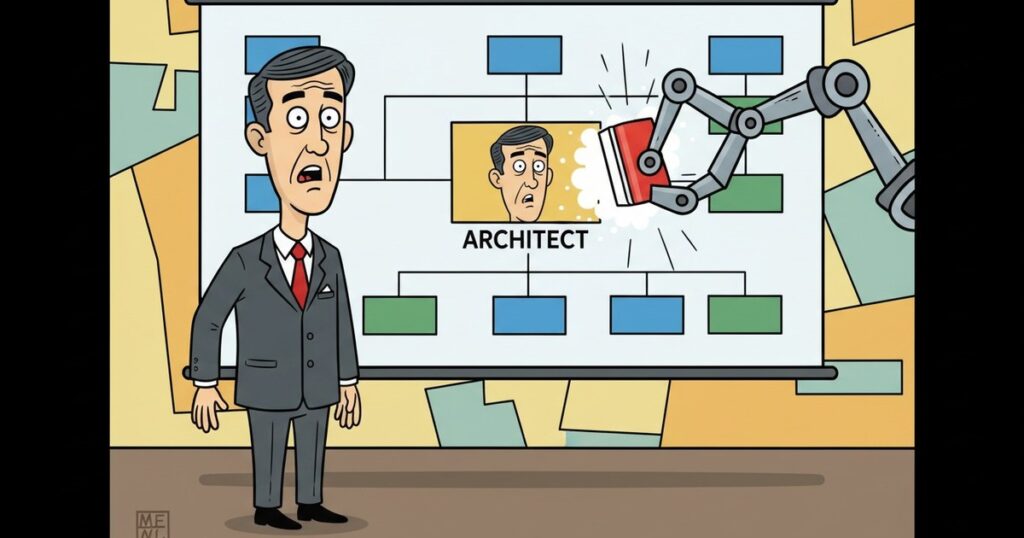

A cloud services company in Riyadh is hunting for a Senior Solutions Architect — Data & AI. The posting is a confession dressed as a hiring notice: they need a human to sit between nervous enterprise customers and a pile of cloud platform services, translating vague business anxiety into architecture diagrams and cost models. The mandatory Arabic fluency is the tell. This isn't an engineering role. It's a trust role. The architect exists because a CXO in a Gulf enterprise will not sign a seven-figure migration contract because a chatbot told him to.
Fair enough. But let's be honest about what this person actually does all day, and then let's be honest about how much of it a machine handles right now.
What the role actually is
Strip away the "end-to-end solution lifecycle" filler and the job is this: a customer describes a business problem in messy, incomplete sentences. The architect listens, asks structured questions, maps the answers to a known catalog of patterns — lakehouse here, real-time analytics there, a copilot for the executives — draws the boxes and arrows, prices it, and writes a proposal that makes the whole thing sound inevitable. Then they stand in front of a room of stakeholders and perform confidence until everyone nods.
The technical surface area is broad but shallow at the decision layer. The architect is not building the data pipeline. They are selecting which managed service does it, estimating what it will cost at scale, and drawing a roadmap that a delivery team will later suffer under. The real product is the artifact: the architecture diagram, the TCO model, the implementation roadmap, the value proposition. Four documents. That's the deliverable. Everything else is meetings.
How AI takes the pipeline
Start with discovery. A senior architect walks into a customer engagement with a mental checklist: what are your data sources, what volumes, what latency requirements, what compliance constraints, what existing licensing are you already paying for. An LLM with a structured prompt chain runs this exact interview. Feed it the customer's RFP, their public technical blog posts, their job postings — job postings are a goldmine for understanding a company's actual tech stack — and it arrives at the first meeting already knowing more about the customer's infrastructure than most human architects would after week two. The discovery workshop becomes a confirmation exercise.
Architecture definition is the next domino. The catalog of patterns is finite and well-documented. Modern data platform? Medallion architecture in a lakehouse, streaming layer with event hubs, serving layer through a warehouse, semantic layer for BI. AI/ML solution? RAG pipeline with a vector store, an orchestration layer, a grounding strategy, guardrails. These are not novel designs. They are compositions of known components, and composition is exactly what current models do well. Give the model the discovery output, the customer's constraints, and a directive to optimize for cost on the cloud provider's pricing API — it produces a reference architecture, selects the services, and generates the diagram. The boxes and arrows that a human would draw in a diagramming tool, the model generates as code and renders directly.
Cost modeling is the most automated thing in the entire role. The cloud provider publishes pricing. The architect estimates usage. This is arithmetic with assumptions. A model that can read an architecture, estimate throughput per component, query current pricing, and produce a TCO table with sensitivity ranges is not a future capability — it is a script a competent engineer could wire together in an afternoon. The "cost optimization" framing in the JD is really just "try the same design with three different service tiers and show the delta." That's a loop, not a judgment call.
The proposal writes itself. The value proposition aligned to business outcomes is the one piece of text in the whole pipeline that sounds like it requires a human, and it is the piece that AI generates most fluently. "Reduce inventory carrying costs by enabling real-time demand sensing across your supply chain" — that sentence writes itself once the architecture is pinned. The implementation roadmap is a Gantt chart with dependencies between standard phases. Ingest, transform, serve, train, deploy, monitor. The model knows the sequence.
So the technical component of the bid — the architecture, the cost model, the roadmap, the value prop — is four artifacts that a well-orchestrated AI pipeline produces from a discovery transcript. The pre-sales leadership that the JD describes as something you "independently drive" is a workflow that a system drives while you review the output.
Where it breaks
Here is where the architect stops being replaceable, and the company knows it, which is why the posting exists.
The first break is trust theater. A CXO signing a multi-year cloud commitment needs to look someone in the eye. That someone needs to have gray hair, or at least convincing posture, and needs to say "yes, I've done this before" in a way that carries weight. The architect's body is part of the product. A bot cannot stand in a room in Riyadh, accept the coffee, read the room's politics, sense which stakeholder is skeptical, and adjust the pitch in real time to neutralize the doubter before the meeting ends. That is a social skill layered on a technical one, and it is the reason "client-facing" appears in the JD like a drumbeat.
The second break is accountability. When the architecture is wrong — when the real-time layer can't handle the volume, when the cost model was optimistic by 40%, when the compliance assumption turns out to violate a local data residency law nobody mentioned in discovery — someone has to be blamed. A human. Preferably a senior one with "Architect" in their title. AI systems do not absorb institutional blame. They do not get fired. They do not have the conversation where they apologize to the customer and commit to a remediation plan. The architect is, in this sense, a liability sink. The company is hiring someone to hold the bag.
The third break is the Arabic requirement itself. The role needs someone who can conduct a technical conversation in Arabic with Middle East enterprise customers — not just translate, but operate fluently in the register of Gulf business culture. AI translation is strong. Cultural fluency in a high-stakes sales context is not the same as translation. The architect who knows when to slow down, when to defer, when to push, and when to let silence do the work — that is not a prompt. That is a person.
The honest verdict
The technical core of this role — discovery, architecture, costing, proposal generation — is automatable today, not in five years. The pipeline exists, the tools exist, the patterns are known. What is not automatable is the social ritual around it: the trusted advisor relationship, the CXO confidence, the blame absorption, the cultural code-switching.
So the role doesn't disappear. It hollows out. The architect of 2027 for this kind of company is a person who shows up to the customer meeting, runs the discovery conversation with an AI system transcribing and generating the architecture in real time behind them, presents the artifacts the system produced, answers questions the system flagged as judgment calls, and signs their name on the proposal. The work is reviewing, approving, and performing. The thinking is done. The person is the packaging.
The company is hiring for a role that is already half-automated and doesn't know it yet. Or worse — they know it, and they're hiring the packaging on purpose.
Either way, the next architect they hire will spend their first month building the internal tooling that makes the second architect unnecessary. The job posting isn't looking for someone to do the work. It's looking for someone to oversee the end of the work — and smile at the customer while it happens.
If you're applying, make sure your Arabic is better than your architecture diagrams. The diagrams are about to write themselves.