
A large Gulf-region bank — the kind with an AI strategy so important it needs three layers of management to describe it — just posted a vacancy for a Senior Vice President & Head of AI Products. The role reports to the Head of AI and Data Science and exists to "translate the bank's AI strategy into an executable portfolio of AI products." That's a confession dressed as a job description.
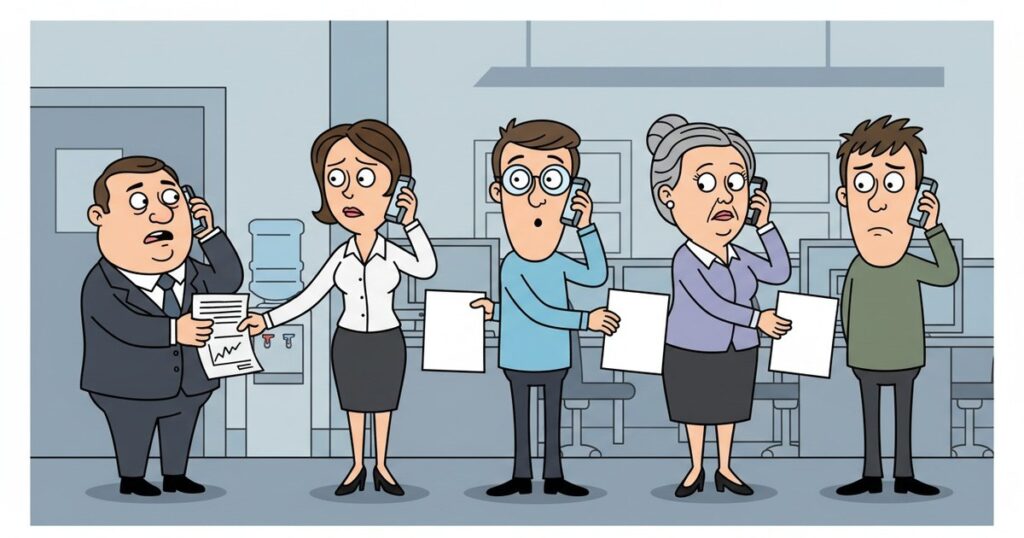
Pause and appreciate the architecture. A human Head of AI and Data Science devises a strategy. A human SVP translates that strategy into a portfolio. Human AI product managers translate the portfolio into roadmaps. Human engineers translate the roadmaps into code. It's a beautiful, expensive game of telephone where the final message is inevitably: build a chatbot for the customer service portal.
The posting is a quiet, magnificent admission: the bank needs a highly paid human to bridge the gap between executive AI fantasies and operational AI reality. But if you follow the logic of the technology this executive is hired to deploy, the telephone game collapses. The AI doesn't just automate the chatbot. It automates the SVP who commissions the chatbot.
Here is how a bank replaces its Head of AI Products with a cluster of large language models and a few cron jobs.
Phase 1: Strategy Translation
The core duty of the SVP is taking the CEO's vague AI ambitions and turning them into a "portfolio of AI products." An automated system does this beautifully. Feed the CEO's annual letter and the bank's strategic slides into a reasoning model. Give it a system prompt: You are a banking AI product strategist. Output five concrete AI initiatives based on this document, categorized by customer-facing, employee productivity, and enterprise risk.
The model reads "enhancing digital customer journeys" and outputs: 1. A generative IVR system for call deflection. 2. A personalized financial wellness assistant in the mobile app. It reads "operational excellence" and outputs: 3. An internal RAG system for policy retrieval. 4. An automated loan-underwriting copilot.
Ninety seconds. The system saves the output to a deck, renders it in the bank's corporate template, and emails it to the Head of AI and Data Science. Strategy translated. Portfolio executable.
Phase 2: Prioritization and Budget
The job description requires the SVP to "manage the AI Lab budget, ensuring effective investment allocation." AI is famously terrible at financial forecasting, but it is phenomenal at bureaucratic theater. Build a script that cross-references the generated product list with the bank's existing tech inventory.
If the CEO wants a "customer-facing AI solution" and the bank already has a legacy chatbot, the script flags the new project as a Phase 2 enhancement and allocates 15% of the lab budget. If it's a net-new internal productivity tool, it allocates 30% and flags it for a pilot. The AI writes the budget justification memo, citing "synergies" and "scalable infrastructure." No human argues over headcount because the headcount is zero.
Phase 3: Delivery and Squad Management
The SVP leads "multidisciplinary teams of AI product managers, engineers, data scientists, and delivery specialists." In the automated bank, this hierarchy flattens into an orchestration loop.
The AI SVP generates Jira tickets directly from the portfolio document. It spins up the necessary cloud infrastructure using Infrastructure-as-Code templates. It writes the prompts for the customer-facing chatbot. It configures the RAG pipeline for the internal policy bot by pointing it at the bank's SharePoint directory.
When the "engineers" — now autonomous coding agents — hit a snag, the AI SVP reprioritizes the sprint automatically, pushing the enterprise risk tool to the next quarter and focusing cloud compute on the mobile app assistant. It does this at 3:00 AM. It does not require a team-building offsite in Ras Al Khaimah.
Phase 4: Executive Reporting
"Prepare and present executive updates for senior stakeholders, including CEO and executive leadership reviews."
This is the easiest part to automate. Create a dashboard that tracks API calls, token costs, user adoption metrics, and deflection rates. Every Friday, the AI SVP generates a three-slide summary. Slide one: a green checkmark next to "Customer AI Assistant." Slide two: a graph going up and to the right. Slide three: a list of "Next Quarter Priorities" generated by the same model that wrote the original strategy.
It doesn't even need to present it. It drops a PDF in the executive Slack channel. The CEO reads it, nods, and replies with a thumbs-up emoji.
Where It Breaks
If this SVP is so easily automated, why did the bank post the job? Because the AI falls apart at the edges of human friction.
The automated SVP cannot handle the bank's compliance department. When the AI generates a plan for an automated loan-underwriting copilot, a human compliance officer will demand a forty-page document explaining how the model avoids redlining and discriminatory bias. The AI SVP can write the document. It cannot sit in a windowless room for three hours, drinking bitter coffee, patiently explaining to the Chief Risk Officer that the model uses explainable AI techniques and doesn't actually make the final decision.
It cannot manage the political fallout when the employee productivity AI accidentally surfaces a confidential memo from the CFO to the entire retail banking division. It cannot build "strategic relationships with technology partners, hyperscalers, and AI vendors" by taking a hyperscaler's sales lead to an expensive steak dinner and agreeing to a joint press release.
The AI can generate the portfolio. It cannot defend the portfolio when the Head of Retail Banking storms into the AI Lab demanding to know why the new chatbot keeps telling customers to reset their passwords by deleting their accounts. The technology is ready to do the executive's job. It is not ready to absorb the executive's blame.
The Verdict
The bank is hiring a Senior Vice President to operationalize AI. The irony is that operationalizing AI is the one thing AI does best. The real job here isn't product management. It's liability management. The bank is paying an executive salary for a human to stand between the technology and the regulators, taking the hit when the inevitable glitch occurs.
So apply if you want. But know that your job isn't to build AI products. Your job is to be the human shield for a machine you don't fully control. And when the next AI strategy document drops, don't bother reading it — your replacement probably wrote it.