
A large global IT services firm — the kind that sends 400-slide decks about "digital transformation" to ministries whose ministers still print their emails — just posted a vacancy. They want an AI Go-To-Market Consultant for the public sector across the Middle East. Ten-plus years of experience. Trusted advisor to senior stakeholders. Someone to "identify, shape, and accelerate AI transformation initiatives" for government clients.
Here is the quiet joke inside that posting. The job is to walk into a government office, listen to what the client says they want, translate it into a strategy document, attach an ROI model, wrap it in a proposal, and shepherd it through approval until someone signs a statement of work. That is a pipeline. Pipelines are what machines are for.
Let us replace the consultant.
What the role actually does
Strip away the "entrepreneurial mindset" and "intellectual curiosity" and what remains is a sequence of well-defined transformations. The consultant takes messy client priorities and produces structured deliverables: AI strategy documents, operating models, governance frameworks, transformation roadmaps, business cases, ROI models, proof-of-concept plans, and proposals. Each of these is a document with a known shape, a known audience, and a known set of conventions. The consultant is, fundamentally, a document-generation engine trained on ten years of prior engagements and fine-tuned by whatever was served at the last client lunch.
The other half of the job is relational: workshops, stakeholder interviews, "navigating ambiguity." This is the part the job posting puts first because it sounds human and important. In practice it is information extraction. You sit in a room, ask questions, and write down what people say. A machine can sit in that room too. It just needs ears.
The pipeline that replaces the human
Here is how you build the AI GTM consultant for a public-sector practice in the Middle East, using nothing more exotic than components available today.
Stage one: intake. A meeting transcription system — the kind that runs on a laptop, separates speakers, and outputs a clean transcript — captures every stakeholder workshop, discovery call, and steering committee. The consultant's notebook, historically a leather Moleskine full of abbreviations only the consultant could decode, becomes a structured JSON object. A language model with a long context window ingests the transcript and extracts: stated priorities, constraints, budget signals, political sensitivities, existing technology stack, named stakeholders and their apparent decision weights — their influence, their patience for jargon.
Stage two: strategy synthesis. The extracted priorities feed a retrieval-augmented generation pipeline. The retrieval corpus is the firm's own engagement library — every prior AI strategy deck, every governance framework, every operating model the firm has ever delivered to a government client, scrubbed of confidentiality but rich in pattern. The model does not hallucinate a strategy from nothing. It composes one from the firm's own institutional muscle memory, calibrated against the specific priorities extracted in stage one. Output: a draft AI strategy document with the same structure the human consultant would have produced — because the human consultant was also producing it from the same institutional muscle memory, just slower and with more coffee.
Stage three: the artefact factory. Each downstream deliverable becomes a templated generation task. The ROI model is a spreadsheet with assumptions pulled from the transcript and benchmarks pulled from the corpus. The governance framework is a living document that inherits from the firm's standard public-sector governance template and specialises itself to the client's regulatory context — which, in the Middle East public sector, is a relatively small number of well-known frameworks that a model can be fine-tuned on directly. The transformation roadmap is a Gantt chart whose phases, durations, and dependencies are drawn from prior engagements of similar scope. The proposal is the strategy document wearing a suit.
Stage four: stakeholder simulation. Before any document goes to a real client, a second model instance role-plays the client. It has been given the client organisation's public profile, the minister's stated priorities from last year's strategy announcement, the regulatory environment, and the political constraints. It reads the proposal and generates the objections the real client will raise — because the real client will raise the same objections, because every client in this sector raises the same objections, because the constraints that produce the objections are structural. The model revises the proposal to pre-empt them. Senior consultants do this after ten years. The model does it after ten seconds of inference.
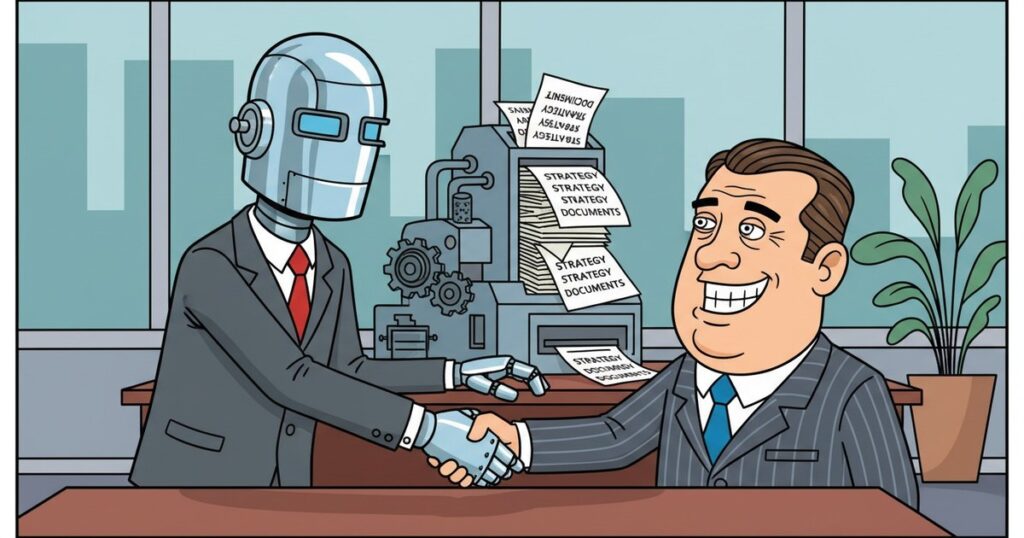
Stage five: the human touch. A person — possibly the same person who used to be the AI consultant, possibly someone more junior and much cheaper — reviews the final artefacts, attends the pitch meeting, shakes hands, and signs the proposal on behalf of the firm. This person is not the consultant. This person is the warm body that makes the client comfortable. Their job is to exist in the room and be smiled at. The thinking is done.
Where it breaks
Here is the honest part, because without it the rest is just a party trick.
The pipeline above handles the document factory perfectly. It handles stakeholder mapping well. It handles ROI modelling adequately, because ROI models in consulting are always fiction dressed in numbers, and language models are excellent at fiction dressed in numbers.
What it does not handle is trust.
Government procurement in the Middle East — like government procurement everywhere, but with particular cultural texture — runs on relationships. Not corrupt relationships, necessarily, but the kind of relationship where a deputy director-general will not sign a forty-million-dirham transformation programme because a slide deck told him to. He signs it because he has had dinner with the firm's leadership. Because his counterpart at another ministry used the same firm and it went well. Because someone he trusts said it would be fine. This is not in the transcript. It is not in the corpus. It is in the years of shared meals, conference corridors, and phone calls that constitute the actual substrate of public-sector consulting.
The AI can write the strategy. It cannot host the dinner.
It also cannot absorb blame. When a transformation programme goes sideways — and they always go sideways — a government client needs someone to hold responsible. A firm cannot point at a language model and say "the algorithm recommended we build a generative AI citizen-services chatbot and it told citizens to file their taxes in the form of a poem." The client needs a name, a face, and someone whose performance review can be affected. The consultant is, in part, a liability sponge. That function does not automate.
And there is a deeper problem. The consultant's value is not just in producing the strategy document. It is in the production of the strategy document being credible because a ten-year veteran produced it. The artefact is a signal, and the signal's value depends on who sent it. A government ministry will not pay premium consulting rates for a document it knows came from a model. It will pay those rates for a document it believes came from a person with grey hair and a track record — even if, or especially if, that person used a model to produce it. The consultant is, in this sense, a brand. The brand is the human. Remove the human and the premium evaporates.
The verdict
The firm that posted this vacancy is hiring someone to do a job that software can already do, at a salary that would fund the compute for a hundred thousand inference calls, for a role whose deliverables are documents that a pipeline can generate in minutes instead of weeks. The ten years of experience they are asking for is a training corpus they could have built themselves from their own engagement archives. The "entrepreneurial mindset" is a prompt. The "ability to navigate ambiguity" is a temperature setting.
What the firm is really hiring — and what it should be honest about — is a person to attend the dinners, absorb the blame, and put their face on the cover page so the client feels safe. That is a real job. It might even be worth the salary. But it is not the job described in the posting.
The posting describes a document engine with a handshake attached. The engine is built. The handshake still needs a hand.
So here is the dare to whoever applies: walk into that first client meeting, open your laptop, and show them the strategy document your pipeline drafted overnight. Watch their faces. Then ask yourself which part of the room they are really paying for — the document, or you. If the answer makes you uncomfortable, good. You are now the last human in a process that no longer needs one, and the only thing keeping you in the room is that the client has not figured that out yet.
They will.