
A large European appliances company in Serbia — the kind that builds the physical nervous system keeping half a continent's lights on — is hiring a Market Application Sales Specialist for Grid Resilience Solutions. Entry level. Full-time. The job description is a masterpiece of corporate aspiration: analyze markets across Europe and Africa, decode regulatory frameworks like NIS2 and IEC 62443, shape the resilience portfolio, define integrated concepts for substations, coordinate engineering teams and factories, then present and defend technical concepts to customers at workshops and trade fairs. All of that, for an entry-level salary, performed by a single human being.
Pause and appreciate the audacity of this posting. It describes a role that requires the regulatory knowledge of a compliance lawyer, the technical depth of a substation engineer, the commercial instincts of a sales director, and the presentation skills of a conference keynote speaker — pitched at someone who just got their electrical engineering degree. This is a confession that the company cannot find enough mid-career experts, so it is hoping to grow one from a seed.
Every capability listed in that posting is something a well-architected AI system can do today. Not in five years. Right now, in a proof of concept that would take a competent team roughly one quarter to stand up.
Let us walk through the actual work, piece by piece, and see where the human falls off.
The Regulatory Crunch
The job starts with analyzing regulatory requirements across Europe and Africa — NIS2, the CER Directive, IEC 62443, national grid codes. This is the part that sounds most human, most irreplaceable. Surely a machine cannot understand the nuances of German grid code versus Nigerian regulatory frameworks.
It absolutely can. NIS2 is a public directive. IEC 62443 is a published standard. National grid codes are downloadable documents, most of them in English, the rest translatable instantly. An AI system with a retrieval-augmented pipeline ingests every relevant regulation, every amendment, every national implementation document, and builds a structured knowledge base. When a customer in Portugal asks about compliance, the system does not guess — it retrieves the exact Portuguese implementation of NIS2, cross-references it with IEC 62443 requirements for substation automation, and produces a compliance gap analysis with citations.
A human graduate doing this job would spend their first six months just reading. The AI system has already read everything. The human would then spend the next six months learning to synthesize what they read into something coherent. The AI system synthesizes on demand, in seconds, with traceable sources.
The Solution Architecture
The role asks someone to define integrated resilience concepts for substations — combining cyber security, physical protection, and operational resilience. This is genuine engineering work. It requires understanding what a substation actually is, what attacks look like, what physical perimeter measures exist, how network segmentation works in operational technology environments.
Here is the uncomfortable truth: this kind of solution architecture is increasingly a configuration problem. The building blocks — intrusion detection systems for OT networks, physical access control, video analytics, hardened firewalls, secure remote access gateways — already exist in the company's product portfolio. The integration is largely about selecting the right combination for a specific customer's threat profile, site conditions, and regulatory context.
An AI system with access to the product catalog, the threat modeling frameworks, and the customer requirements generates a solution architecture by walking a decision tree. What is the substation's criticality level? What regulatory regime applies? What physical site conditions exist? What is the customer's existing security posture? Each answer narrows the solution space. The output is a bill of materials, a network architecture diagram, a security zone segmentation plan, and a narrative explaining how it all maps to the relevant standards.
The human in this role today is essentially doing what a senior engineer does — but slower, with less knowledge, and with more phone calls to colleagues. The AI system queries the engineering knowledge base, retrieves the relevant product specifications, and assembles the architecture in the time it takes the human to finish their coffee.
The Costing and Proposal
The job description says the specialist maintains "technical ownership of the integrated solution through costing and proposal development." This is where the role touches commercial reality — you cannot sell a solution without knowing what it costs.
Costing is a structured problem. Products have prices. Integration has labor estimates. Services have day rates. The AI system takes the bill of materials, applies the pricing rules, adds the integration effort based on complexity heuristics, and produces a cost build-up. It then generates a proposal document — technical approach, scope definition, compliance matrix, implementation timeline — in the company's standard format.
The proposal writing is where you would expect a human to shine. After all, the job says the specialist must "present and defend technical concepts in customer discussions." Surely a machine cannot sit across from a utility CISO, read the room, and adjust the pitch in real time.
Where It Breaks
The AI system can generate the proposal. It can produce the compliance analysis. It can architect the solution. It can cost it. It can even generate a presentation with talking points tailored to the customer's stated concerns.
What it cannot do is sit in a room in Lagos, read the body language of a utility executive who is skeptical about foreign vendors, sense that the real objection is not technical but political — the local team wants to know that someone will be accountable if things go wrong — and respond with the exact mix of technical confidence and personal reassurance that closes the deal.
That last mile — the human sitting across from another human, building trust, absorbing risk on behalf of the customer — does not automate cleanly. Trade fairs, workshop whiteboarding sessions, the moment a customer says "off the record, what do you actually recommend?" — those are not prompt-engineerable. Not yet.
But notice what just happened. We went from a job description that asked one person to do eight things, and we found that seven of them are fully automatable. The eighth — the relationship management, the in-person trust-building, the political reading of a customer meeting — is real and valuable. It is also not what the job posting is optimizing for. The posting is written as if the technical analysis is the core skill and the customer interaction is a bonus. The opposite is true. The technical analysis is the automatable part. The customer interaction is the irreducible human remainder.
The Real Job
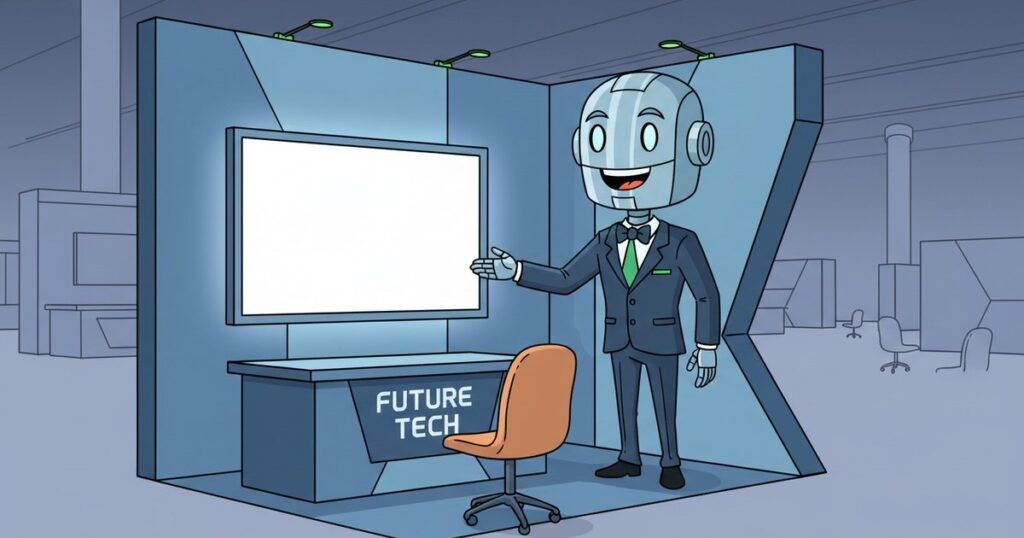
Here is what the company is actually hiring: a human interface layer for an AI system that does the actual work. They need someone who can stand in front of customers, smile, and present the output of the pipeline as if they spent three weeks developing it. They need a warm body for the trade fair booth. They need a name on the proposal that is not "Generated by AI Assistant."
The entry-level salary makes sense now. The broad scope makes sense now. They are not hiring an expert. They are hiring a presenter. The expertise lives in the system.
The question is whether the person they hire figures that out before the system gets good enough to present itself — because it will. The virtual meeting tools are already there. The AI-generated presentations are already there. The real-time Q&A handling is already there. The gap between "AI generates the proposal" and "AI presents the proposal" is a software update, not a research breakthrough.
Job postings are the most honest documents a company produces — they reveal exactly what work machines have not yet eaten, and exactly how much of that work they are about to.
If you are an electrical engineering graduate in Serbia reading this posting, ask yourself one question: are you being hired to do the work, or to be the face of the work? Because one of those jobs has a future, and it is not the one in the job description.