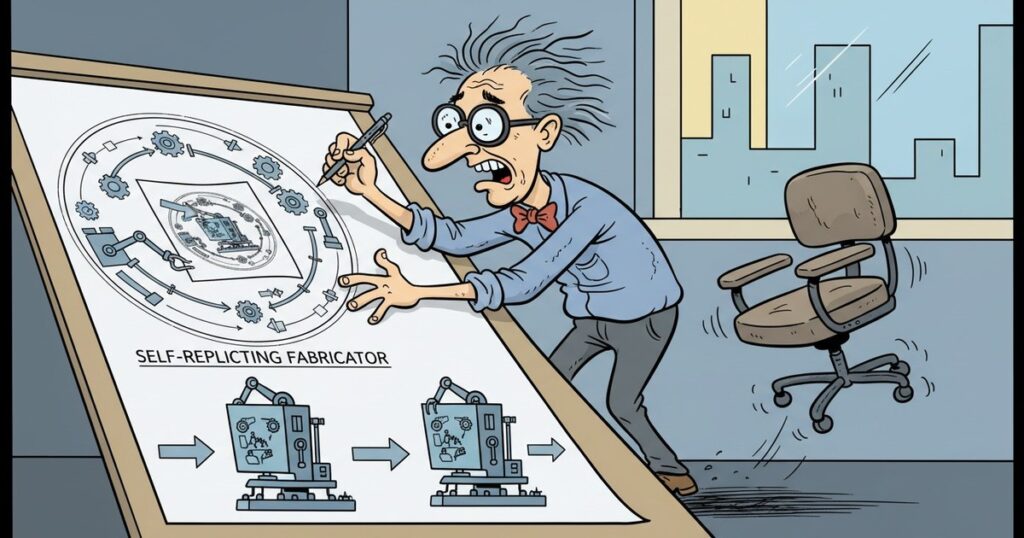

A European strategic consultancy — the kind that brags about 1,200 projects across 18 countries and counts multilateral development banks among its clients — just posted a job. They want an Enterprise AI Architect. Mid-senior level. Someone to "design end-to-end architectures for AI solutions, platforms and programs, from data ingestion and retrieval to models, agents, applications, integration and observability."
Read that sentence again. Then notice what it's quietly admitting: a human, today, manually translates business requirements into technical designs, draws reference architectures on a slide, and tells client CIOs which RAG pattern to pick. A human. In 2025. For a job that is entirely about teaching machines to do human work.
The consultancy wants someone to build the AI systems that will replace their clients' employees. Fine. But the architect's own chair is the most automatable seat in the room.
What the role actually does
Strip away the consulting varnish and the JD is a list of well-defined design tasks:
- Translate requirements into architecture. Business says "we want a document intelligence assistant that reads our contracts and flags risk." Architect decides: chunking strategy, embedding model, vector store, retrieval pattern, guardrails, evaluation harness, integration path to the document platform, identity passthrough, logging.
- Maintain reference architectures. A library of pre-validated blueprints — RAG pattern A, agentic workflow pattern B, predictive-plus-gen-AI pattern C — with decision trees for when to use which.
- Integrate with enterprise systems. ERP, CRM, office productivity suites, document management platforms, data warehouses, legacy APIs. The architect maps the data flows, the auth boundaries, the sync schedules.
- Advise and estimate. Stand in front of a client CIO, explain trade-offs, attach numbers to a proposal, pick vendors.
- Review engineering work. "Production-readiness and quality reviews" — a gatekeeper function, checking that what was built matches the architecture and won't fall over on Monday.
Every single one of those is a pattern-matching exercise operating over a finite universe of known components. Which is a polite way of saying: a sufficiently good language model already knows all of this.
How AI replaces this role, step by step
The reference architecture engine
Build a system that holds the consultancy's entire architecture knowledge base: every past project's design doc, every integration pattern, every vendor comparison, every post-mortem. Index it. Feed a new client's requirements into a planning agent that retrieves the closest matching past architectures, adapts them to the new constraints, and outputs a full design document — ingestion layer, model selection, retrieval strategy, agent topology, security boundaries, observability plan, cost estimate.
This is not science fiction. The components exist today: a vector store for the knowledge base, a retrieval-augmented planning agent, a structured output schema for architecture documents. The agent would produce a 40-page design doc in the format the consultancy already uses — because it learned from the 1,200 previous ones.
The human architect currently takes two weeks to produce that document. The agent takes two minutes. The consultancy bills the client for the two weeks either way. That's the part they like.
The integration mapper
"Secure integration with ERP, CRM, office productivity suites, document management platforms, data warehouses, APIs and legacy systems." This is a mapping problem. Given a target system's API documentation and the desired data flow, an agent can generate the integration design: which endpoints, which auth method, which sync frequency, which error-handling strategy, which fields to mask for privacy.
Integration patterns for mainstream office and document platforms are documented exhaustively. ERP connectors are catalogued by vendor. CRM APIs are stable and well-described. An agent with access to API documentation and the consultancy's own integration playbook produces the integration architecture in the time it takes to read this paragraph.
The advisory and estimation layer
"Advise client CIOs, CTOs, data leaders, architects and security teams on architecture choices, trade-offs and technology roadmaps." An advisory agent fine-tuned on the consultancy's past proposals and client transcripts can generate trade-off analyses, comparison matrices, and roadmap recommendations. It can produce the exact slide deck the human architect would present — because it trained on every slide deck the human architect ever made.
The client CIO doesn't need to know a model generated the recommendation. They need a defensible architecture with clear trade-offs. The model produces one. The consultancy's partner reviews it for sanity — fifteen minutes, not two days — and ships it.
The design review gate
"Review major solution designs and support production-readiness and quality reviews." This is the most automatable task of all. A review agent takes a proposed architecture and checks it against the consultancy's standards: Is there a retrieval evaluation harness? Is identity passthrough designed for the target system? Is there a human-in-the-loop checkpoint for the agentic workflow? Is the vector store sized for the expected document volume? Is there a fallback for when the LLM provider has an outage?
The agent outputs a checklist with pass/fail per criterion and specific remediation notes. The human architect currently does this in a review meeting. The agent does it continuously, on every design, the moment it's submitted.
Where it breaks
Here's the honest part, because without it the rest is just a victory lap.
The client relationship is not yet automatable. Client CIOs buy consulting because they want a human to look them in the eye and say "this will work." A model can produce the architecture. A model cannot produce the feeling of a senior person with gray hair and a blazer sitting across the table and saying "we've done this before, you're in good hands." That performance is the product. The architecture is the receipt.
The regulatory and multilateral context resists full automation. When your client is a development bank funding infrastructure in three countries, the compliance constraints are not fully documented in any knowledge base a model can ingest. They live in email threads, in political sensitivities, in unwritten rules about which vendor is acceptable to which government. A model cannot read that room. A human who has been in those rooms can.
The novel edge case. When a client wants something genuinely unprecedented — a combination of constraints no past project has matched — the retrieval-augmented architect has nothing to retrieve. It will hallucinate a plausible-looking architecture that is subtly wrong. A human with deep pattern recognition across failed projects will spot the trap. The model gets better at this over time. It is not there yet.
Internal politics. The consultancy's own AI operations — "the architecture supporting the company's AI-powered operations and common internal AI services" — involve decisions about who owns what, which team's budget pays for the shared platform, which partner's fiefdom gets absorbed. No model navigates that. That's not an architecture problem. That's a human problem wearing architecture clothes.
What survives
The role doesn't vanish. It shrinks and shifts. One architect with the AI tooling does the work of five. The surviving architect is not the one who draws the best diagrams — the model draws those. The survivor is the one who can stand in front of a client and make the model's output feel like judgment rather than generation. The consultant as presenter, not architect. The architecture happens in the background. The consulting happens in the room.
Or, to put it in the language the consultancy would use in its own proposal to a client: the machine does the work, the human takes the credit, and the client pays the same invoice.
Which is consulting-speak for: the machine does the work, the human takes the credit, and the client pays the same invoice.
The dare
The consultancy that posted this role is in the business of telling other companies which jobs AI can replace. They wrote a job posting for the person who will help them do that to their clients. They did not notice — or chose not to notice — that the job they posted is the first one they should run through their own system.
So here's the question for whoever fills this chair: you're going to build the AI architecture that replaces a client's analysts, their document processors, their knowledge workers. When you're done, are you going to architect your way out the door too — or are you counting on being the last one who gets to decide who's replaceable?
Because here's the thing about building automation for a consultancy: the partner who sells it keeps the margin. The architect who built it becomes a line item. And line items, as you'll tell your clients, are exactly what AI is for.