# The Platform Architect Job That Is Just a Prompt

A European retailer is hiring a Platform Architect for AI. Mid-senior level, full-time. The first project is a visual similarity search engine that checks whether store displays match the planogram — snapping shelf photos, embedding them, retrieving the nearest compliant match, flagging the outliers. It pays well. The posting includes the phrase "emerging best practices," which means nobody knows what the best practices are yet, and the company will pay someone to pretend they do.

<!--more-->

## What the architect actually does

The day-to-day is less visionary and more glorified plumber with a whiteboard. The architect reads business requirements, translates them into technical constraints, picks tools, draws data flows, writes architecture decision records, and argues with security about whether a third-party API is safe to call. They evaluate build-versus-buy. They model costs. They worry about GDPR and the EU AI Act. They design rollback paths. They monitor drift. They mentor engineers who are younger and cheaper and will one day replace them — but not before an AI replaces all of them first.

That first project, the visual compliance checker, is something you can prototype in an afternoon. Open-CLIP embeddings, a vector store, a similarity threshold, a dashboard. The architecture is not novel. The decisions are not hard. The hard part is the politics: convincing stakeholders, aligning security, documenting choices so nobody gets blamed later. The architect is organizational liability insurance, dressed up as technical leadership.

## How AI eats this role

Start with the compliance checker. Ingest shelf photos, preprocess, embed with a vision model, store vectors, query against a reference set of compliant displays, return a similarity score, flag anything below threshold. Give an AI the constraints — latency, volume, privacy, budget — and it will produce the boxes, the arrows, the tool choices, the cost estimates, and the risk register. It will write the ADR. It will note that the EU AI Act classifies this as limited-risk and recommend logging. It will draft the security review document. It will do all of this in the time it takes the human architect to finish their coffee.

Move to the broader remit. "Select appropriate technologies, frameworks, and models" is a retrieval problem. The landscape changes fast, but an AI with web access tracks it faster than any human who also has meetings. "Evaluate build vs. buy decisions, including cost modelling and vendor lock-in risk" — a language model produces a build-versus-buy matrix with total cost of ownership, dependency analysis, and exit-strategy notes in minutes. "Guide MLOps practices — retraining triggers, drift monitoring, versioning, rollback paths" — known patterns with documented best practices. An AI enumerates them for the specific stack, generates the monitoring configs, and writes the runbooks. "Create and maintain technical documentation, architecture diagrams, and decision records" — this is literally text generation. It is the thing language models do best.

The mentorship piece is the funniest. "Mentor AI engineers on architecture patterns and emerging best practices." An AI can mentor AI engineers on AI architecture patterns. It can produce up-to-date guides on RAG, fine-tuning, agentic frameworks, vector retrieval. It can review an engineer's proposed design and point out where it will break. It can do this at 3 AM, for free, without getting bored. The human mentor adds warmth. Warmth is not in the job description.

The build-versus-buy decision is itself a build-versus-buy decision. You can hire an architect for a hundred thousand euros a year to evaluate whether to build or buy. Or you can ask an AI to produce the same evaluation, then buy the thing it recommends, and skip the architect entirely. The architect is the middleman in a transaction between the company and its own tooling. Middlemen get disintermediated.

## The pipeline that replaces them

Here is the concrete system. A requirements-to-architecture pipeline. Business stakeholders describe the problem in natural language, or paste a Jira ticket. An AI agent parses it, pulls constraints from the company's existing infrastructure documentation, queries the current landscape of available models and tools, and produces a candidate architecture: data flow diagram, component list, technology choices, cost model, compliance notes, security review draft, and an implementation plan broken into tickets.

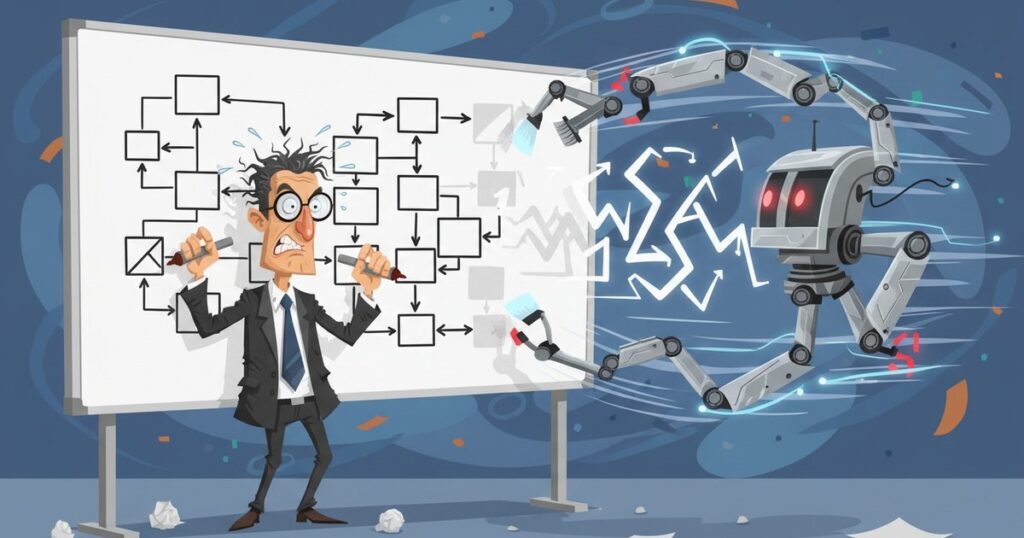
A second agent reviews the output against the company's standards and past decisions. A third agent — the security liaison — checks the third-party integrations against approved vendor lists and flags anything new. The output goes to a human reviewer who has the architect's old job title but now spends most of their time approving things rather than designing them. The AI engineers get the tickets and implement them, sometimes with AI assistance. The architect's whiteboard gathers dust in a meeting room that gets repurposed as a nap room.

The prompts are not magic. They are the job description itself, rewritten as instructions:

> Given these business requirements and these infrastructure constraints, produce an end-to-end AI architecture with the following deliverables: data flow diagram, technology selection with rationale, cost model, GDPR and EU AI Act compliance notes, security review checklist, MLOps monitoring plan, and rollback strategy. Format as ADR.

That is the architect's job, stated as a prompt. The architect's job is a prompt.

## Where it breaks

Here is the honest part. The AI is good at producing architectures. It is bad at knowing which architecture the organization will actually adopt. Politics, stakeholder relationships, institutional memory, the fact that the head of engineering once got burned by a specific vector database and now hates it — these are not in the documentation. The AI does not know that the security team is understaffed and will block anything that requires a new vendor review process for six months. It does not know that the CFO will approve cloud spend but not headcount, which changes the build-versus-buy calculus in a way that doesn't appear in the spreadsheet. It does not know that the first project will succeed technically and fail organizationally because the store managers don't trust the compliance checker and keep overriding it.

The AI also cannot attend the meeting where someone says "we tried this two years ago and it didn't work" and then explains why. That conversation is not in any document. It lives in the architect's head, or in the head of someone the architect buys a coffee. Institutional knowledge is the last thing to automate, because it was never written down.

And the security liaison role — the real one, not the document preparation — requires someone who can look a security engineer in the eye and say "trust me, I've thought about the threat model" and have it mean something. An AI can draft the threat model. It cannot build the trust. Trust is a human protocol running on wet social hardware that has not been upgraded in fifty thousand years.

## The verdict

The company is hiring someone to design the system that will make this hiring unnecessary. The first project — visual compliance — is a warm-up. It is the kind of well-bounded, well-understood problem that proves the pipeline works. Once it works, the pipeline eats the next project, and the next, and the architect's role shrinks from designer to approver to the person who forwards the AI's output to the right Slack channel.

The job posting says "stay current with the AI landscape." The AI landscape is staying current with this job posting. It has read it. It has determined that it can do sixty percent of it today, eighty percent within a year, and ninety-five percent before the architect's probation period ends. The remaining five percent is meetings. Meetings are safe, for now.

Apply if you want. The salary is real. The work is real. But you are building the road that will be driven over you. The first project is a visual similarity search. The last project is you.
Posted inUncategorized
The Platform Architect Job That Is Just a Prompt