
A performance-marketing services company in Bosnia — the kind that acquires B2C customers at scale for large North American clients — is hiring a Creative Team Lead for AI and performance marketing. The posting is a masterpiece of unconscious comedy. They want someone to take a team of three "AI-driven Creative Designers," scale it to six, and "build the company's visual creative engine." The lead will partner with a "Generative AI Pipeline Engineer," own the creative testing loop, and track new AI models.
Read that again. They are hiring a human to manage a team of humans whose entire job is to prompt a machine, partnered with another human whose job is to build the machine that will eventually not need the prompters. This is not a job description. It is a fossil forming in real time.
What the role really does
The team produces static ad creatives and photorealistic AI visuals for performance campaigns across paid media. A brief or a hypothesis comes in. A creative that converts goes out. The lead owns the production flow: task distribution, capacity planning, strict quality control. They drive creative direction — concepts, hooks, visual angles that stop the scroll. They run the testing loop: logging winners, analyzing failures, feeding performance data into the next iteration. And they manage people: mentoring, growing the team from three to six.
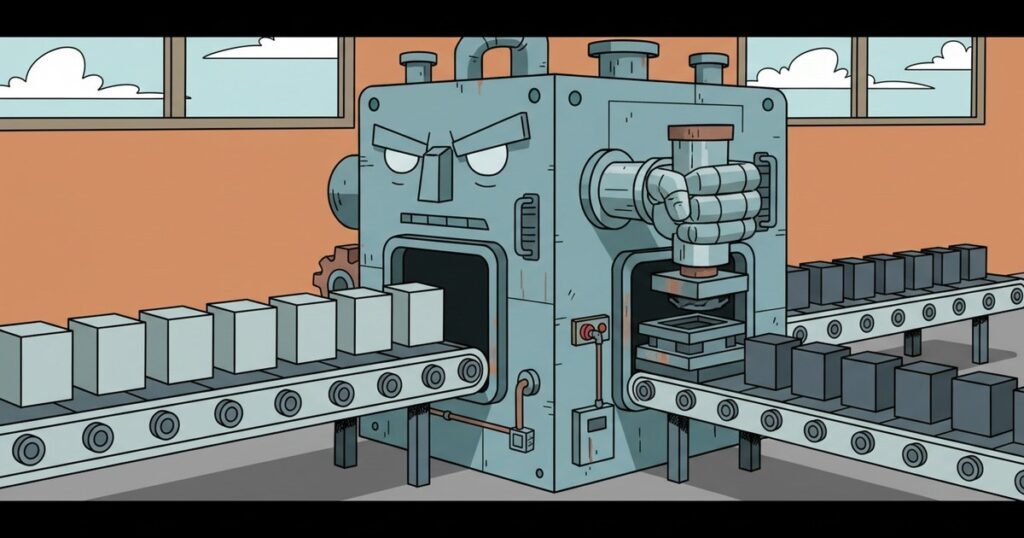
It is a factory. A factory whose raw material is a text prompt and whose product is a JPEG that makes someone click. Every step in that factory is a function of either generation, selection, or routing — and those are precisely the things AI systems are built to do autonomously.
How the pipeline eats the team
Here is the system that replaces the six designers, the lead, and most of the surrounding creative apparatus. Every component exists today; the assembly is the only novel part.
Step one: the brief becomes a structured creative request. A media buyer or a marketer enters a campaign goal, a target audience, a platform, and a budget into a form. A large language model takes those inputs, pulls historical creative-performance data from the company's database, and generates a set of creative hypotheses — structured briefs with specific visual angles, color palettes, scroll-stopping hooks, and composition notes. This is the "creative direction" the lead currently owns. The model does it by pattern-matching against every winning creative in the company's archive, cross-referenced with competitor ads scraped from the major ad platforms' public ad libraries.
Step two: the structured brief becomes a batch of generated images. The system calls an open-source image-generation model — a fine-tuned diffusion model — with the structured brief as the prompt, a brand-specific fine-tune for visual consistency, and a set of parameter variations for rapid A/B testing. Where the current team produces ten variants per concept over two days, the pipeline produces two hundred in twenty minutes. The Generative AI Pipeline Engineer — the one role that survives this teardown, barely — has already built the brand-specific fine-tunes, the prompt templates, the upscaling workflow, and the QC filters that automatically reject images with anatomical horrors or illegible text overlays.
Step three: the generated images are auto-formatted and auto-uploaded. Each creative is resized for every placement the campaign requires, text-safe zones are respected, and the final assets are pushed directly into the ad platform via API. No human touches the file. No one renames it. No one uploads it to a shared drive and messages a link.
Step four: the testing loop runs itself. The ad platform's own algorithm does the creative testing — it always did, that is what performance marketing is. The system reads performance data back through the platform's API, logs winners and losers in the database, and feeds the results back into step one. The next batch of generated creatives is automatically biased toward the visual patterns that won. The loop tightens every cycle without a human in it.
This is the entire job. Brief in, creative out, performance measured, next iteration generated. The "creative testing loop" the lead owns is a while True loop.
What the lead actually contributed
Here is the uncomfortable part. The creative direction — the "concepts, hooks, and visual angles that stop the scroll and convert" — is the piece the posting treats as the sacred human contribution. But the direction was always derived from the same data the model now reads directly. The lead looks at what won last week, looks at what competitors are running, identifies a pattern, and tells the team to iterate on it. That is few-shot learning with extra steps. The model does not need a creative director. It needs a training set, and the company has been building one for years.
The "grow people, not just output" line in the posting is the most poignant detail. The lead is being asked to hire three more humans whose careers will peak at typing prompts into a system that is one integration away from not needing them. The mentoring will consist of teaching junior designers to write better prompts — a skill with a shelf life roughly equal to that of a banana.
Where it breaks
This teardown is not complete without honesty, so here is what does not automate cleanly — yet.
Brand sanity. The pipeline can generate two hundred on-brand images, but "on-brand" in performance marketing is a moving target. A color palette drifts. A visual style that worked for six months suddenly fatigues and the model keeps producing it because the training data is stale. A human still needs to look at the output and say, "this looks cheap," or "this worked in March but it feels tired now." That judgment requires taste, and taste is a compression algorithm we have not fully reverse-engineered.
Client communication. The large North American partners want to talk to a person. They want to see a deck. They want to feel that someone is thinking about their campaign holistically. The system can produce the creatives, but it cannot produce the meeting after the creatives — the one where a human sits across from a client, reads the room, and adjusts the strategy based on a furrowed brow. That is a sales function dressed up as a creative function, and it is the last thing that automates in any service business.
Regulatory and platform compliance edge cases. A model will occasionally generate something that violates a platform's ad policy or a client's industry regulations. The QC filters catch the obvious ones, but the novel edge case — a visual that is fine in one jurisdiction and illegal in another — still needs a human reviewer. This is a shrinking surface area, but it is not yet zero.
The pipeline engineer's job. Someone has to maintain the fine-tunes, update the prompt templates when a new model drops, rebuild the workflow when an API changes, and integrate the next generation of image models. That role survives. But it is one person, not seven.
The verdict
The company is hiring a lead to scale a team from three to six. The honest version of this posting would hire one pipeline engineer to maintain the system and one account manager to talk to the clients. The lead's role — the creative direction, the production flow, the testing loop, the people management — is middleware between a database of winning creatives and an image-generation model. Middleware gets abstracted away. That is what the word "pipeline" means.
The posting says the company wants someone who is "equal parts creative leader, marketer, and AI geek." The person they actually need is the one who can build the pipeline, watch it run, and then sit in the client meeting pretending the creatives took longer to make than they did. That is not a Creative Team Lead. That is an operator of a machine that has already replaced the team.
If you are the person who can build that pipeline, take the job. But negotiate for equity, not a team headcount. The headcount is a liability. The pipeline is the asset.
And if you are one of the three existing "AI-driven Creative Designers" — update your professional profile. The role you have right now is the one the entire industry is quietly converting into a cron job.