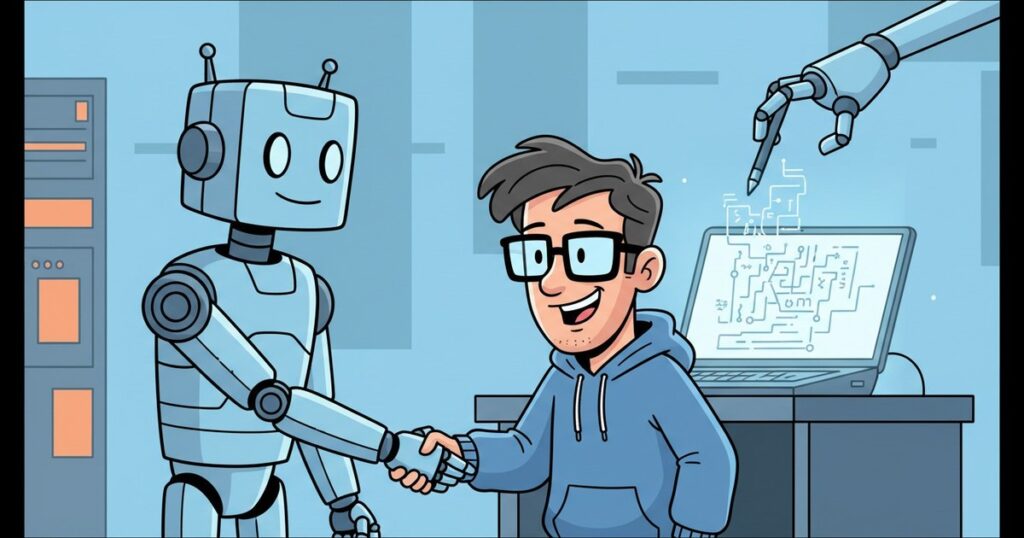

A major European computer hardware manufacturer is hiring a Senior Developer Relations Manager for its "AI Natives" ecosystem. The job description reads like a love letter to human connection: "trusted technical advisor," "champion for the developer ecosystem," "foster co-innovation." It's a job about walking into a startup's engineering room, understanding their stack, and patiently explaining how your company's AI hardware will make their workloads fly. And it is a job a machine could do.
What This Role Actually Does
Let's strip the poetry. A Senior Developer Relations Manager at a deep-tech computing platform does three things:
- Technical matchmaking: You find startups building AI workloads, figure out what they're doing, and show them how to integrate your company's compute stack — GPUs, SDKs, inference engines — into their pipelines.
- Enablement content: You produce sample code, integration guides, and demo pipelines that make adopting your platform frictionless.
- Ecosystem intelligence: You map who is building what, feed that intelligence back to your product teams, and shape the roadmap based on what developers in the field actually need.
The rest — the conference talks, the Slack community management, the "co-innovation sessions" — is theater built around this work. And all three are automatable. Now.
How AI Replaces the Matchmaking
The first function — finding the right developers and showing them the right integration path — is a retrieval and generation problem.
You build a pipeline that continuously ingests GitHub repositories, arXiv preprints, Hacker News threads, and startup landing pages, looking for projects that match your platform's sweet spot: teams training or fine-tuning models that would benefit from your specific hardware accelerators. A classifier scores each lead on technical fit and adoption likelihood.
When it finds a match, an LLM drafts the outreach. Not a generic "Dear Founder" blast. A specific technical teardown: "Your repo shows you're running PyTorch training loops on standard cloud GPUs. Here's a migration path to our platform that would cut your inference latency, with the exact config changes and a working code snippet." It attaches a runnable notebook. It references their actual architecture. It is, functionally, what a good DevRel manager spends their first hour of every morning doing — except it does it for five hundred leads before lunch.
The startup's CTO receives this. It reads like a deeply technical person spent an afternoon studying their repo. It actually took four seconds. If they reply, a conversational agent handles the back-and-forth — answering integration questions, debugging setup issues, pulling from your platform's documentation and codebase. When the conversation hits a real blocker, it escalates to a human solutions architect. By that point, the lead is warm, the technical fit is proven, and the architect is spending their time on the 5% of cases that actually need a human brain instead of doing discovery calls with every startup that vaguely mentions "transformers" on its About page.
How AI Replaces the Enablement Content
The second function — sample code, guides, demo pipelines — is where the replacement gets almost funny. The job is literally asking an AI to produce content about how to use AI.
You set up a system that monitors your platform's API changes, SDK updates, and new hardware releases. Every time something ships, an LLM generates the corresponding integration guide, code sample, and demo pipeline automatically. It tests the code against a sandbox. It formats the docs. It publishes them.
Today, a DevRel manager reads the engineering team's release notes, sits down, and writes a "Getting Started with X" tutorial. Tomorrow, that tutorial writes itself the moment the PR merges. The DevRel manager's editorial judgment — "which examples resonate with developers?" — becomes a prompt template refined by tracking which generated guides get the most GitHub stars and forks. The feedback loop closes itself.
The demo pipelines? Same thing. A system that generates a working, containerized demo for each major use case — LLM inference, image generation, vector search — and keeps it updated as dependencies shift. The DevRel manager's job of "building compelling demos" becomes "maintaining the prompt that generates compelling demos." That's a part-time task. For one person. For the whole EMEA region.
How AI Replaces the Ecosystem Intelligence
The third function — mapping the developer ecosystem and feeding insights back to product — is pure data processing. The same ingestion pipeline that finds leads also produces the intelligence: which frameworks are gaining traction, which integration patterns developers are struggling with, which competitor platforms are being discussed in the communities you monitor.
A weekly LLM-generated briefing goes to product management: "This week, 340 EMEA repos adopted the framework your platform doesn't yet support natively. Here are the three most common integration pain points, with links to the relevant threads. Here is a suggested roadmap adjustment." That's the "actionable insights from field deployments to influence product roadmaps" the job description asks for — produced without anyone booking a single flight to Stockholm.
Where It Breaks
Here's the catch, and it's a real one.
Developer relations runs on trust, and trust runs on the social contract that there is a human being on the other end who has staked their professional reputation on the technical advice they're giving you. When a startup's lead engineer is deciding whether to rip out their existing inference stack and bet on your platform, they want to look someone in the eye — even over Zoom — and ask, "Is this actually going to work for my workload, or are you selling me?" An AI-generated email with a runnable notebook gets you in the door. A human closes the deal, because the decision is career-risk for the engineer on the other side, and they need a name to blame if it goes sideways.
The other thing that doesn't automate cleanly is the strategic relationship layer — the "let's do a joint announcement at the conference" conversations, the navigating of internal politics to get a startup priority support, the reading of a room where a partner is frustrated but too polite to say so in a Slack channel. That's pattern recognition on social signals that current systems are genuinely bad at, because the training data for "reading a frustrated CTO" is not something you can scrape from GitHub.
So the role doesn't vanish. It shrinks. The DevRel team of five becomes a DevRel team of one, managing the automation, handling the relationship-critical conversations, and stepping in when the AI's outreach hits a lead who wants to talk to a human before betting their roadmap on your SDK. The job posting asks for someone to "serve as the trusted technical advisor" across an entire ecosystem. The AI serves the technical part. The human keeps the trust.
The Verdict
A company that builds AI platforms is hiring a human to persuade developers to use those AI platforms, and the persuasion itself is an AI problem. The outreach is generation. The enablement is generation. The ecosystem mapping is retrieval. The only part that isn't is the handshake — and even that's getting squeezed.
If you make AI accelerators and you can't use them to automate the job of convincing people to use your AI accelerators, what exactly is the pitch?
The real question isn't whether this role gets automated. It's whether the person they hire will admit that their first task is to build the system that makes their fifth task unnecessary — or whether they'll keep writing those integration guides by hand and pretending the clock isn't running.