
A fast-growing European fashion e-commerce company — Hamburg and Berlin offices, flat hierarchies, team lunches, the whole cultural script — is hiring a Head of Engineering for its Commerce Finance Tech unit. The role leads two teams building the bridge between the commerce platform and the ERP, ensuring regulatory compliance, and standing up the data platform that runs the financial pipelines.
The job description says this person "questions business requirements to balance technical complexity." Read that sentence again. The entire role, distilled, is: translate money noise into system decisions, then convince humans to fund them. That is a pipeline. That is automatable.
What the role actually does
Strip the leadership language and here is the function: the Commerce Finance Tech unit ingests transactional data from the shop, maps it onto ERP structures, validates it against regulatory rules, and serves it back to stakeholders as reliable financial truth. The Head of Engineering decides which architecture supports that flow, who builds it, and whether the business actually needs what it asked for.
The title bundles three functions:
- Architect — designing how finance data moves, transforms, and lands.
- Gatekeeper — filtering stakeholder requests through a "is this worth the engineering cost" lens.
- Manager — hiring, coaching, running two teams, reporting upward.
Jobs one and two are decision problems with structured inputs. Job three is the one that keeps the org chart from collapsing. Only one of these requires a pulse.
The replacement
The architecture engine
Feed the AI the current system landscape — the ERP connector patterns, the data platform schemas, the pipeline orchestration tool, the compliance ruleset for the jurisdictions the company sells into. All of this already exists as documentation, tickets, and code. An LLM with repository access and a vector store of past architectural decisions does not need a human to "design" the next one. It needs a prompt: here is the new regulatory requirement, here is the current data flow, produce the architecture decision record. The ADR comes out. It cites the existing patterns. It flags where new infrastructure is required. It estimates the migration path. A senior engineer reviews it in fifteen minutes instead of spending two weeks writing it.
The job description's call for "highly scalable technical solutions in close cooperation with our core teams" describes an LLM that has read every service's API contract and can propose the integration that respects existing conventions. It does not need a kickoff meeting.
The requirements filter
"Questioning business requirements to balance technical complexity" is the most automatable sentence in the entire JD. It is a cost-benefit analysis with known variables: engineering hours, risk surface, compliance exposure, downstream maintenance burden, and business value. An AI agent receives the stakeholder request, pulls the relevant codebase context, estimates the implementation complexity, cross-references similar past requests and their outcomes, and returns a verdict: build it, decline it, or build a cheaper version that covers eighty percent of the ask. It even drafts the polite rejection email to the business stakeholder.
This is not science fiction. This is a RAG pipeline over ticketing history plus a reasoning model with access to the codebase and a cost model for engineering effort. The Head of Engineering was doing this in their head. The AI does it in seconds and does not need a coffee between meetings.
The pipeline itself
The financial data pipelines — the actual ingestion, transformation, validation, and serving — are already largely automated in any modern data platform. What the human teams contribute is the glue: the edge-case handling, the schema evolution decisions, the "why did this batch fail at 2 AM" debugging. An AI agent with access to logs, pipeline run history, and the transformation code can triage failures, propose fixes, and in many cases apply them through a pull request that a human approves. The two tech teams shrink. They become review stations, not builders.
Where it breaks
Here is the honest part, because without it the rest is just a tantrum.
The AI cannot do the politics. When the VP wants a feature shipped by quarter-end and the architecture says it should take two quarters, someone has to walk into a room and have a conversation that is ninety percent trust and ten percent technical argument. The AI can produce the argument. It cannot produce the trust. Not in a European company where "direct communication" and "pragmatic decisions" still run on personal credibility built over team lunches and after-work drinks.
The AI also cannot hire. Not because it cannot assess technical skill — give it a codebase and a candidate's pull requests and it will rank them — but because hiring at this level is a bet on a person's judgment under ambiguity, and that assessment is itself an ambiguous judgment call. The loop is circular. You need a human to break it.
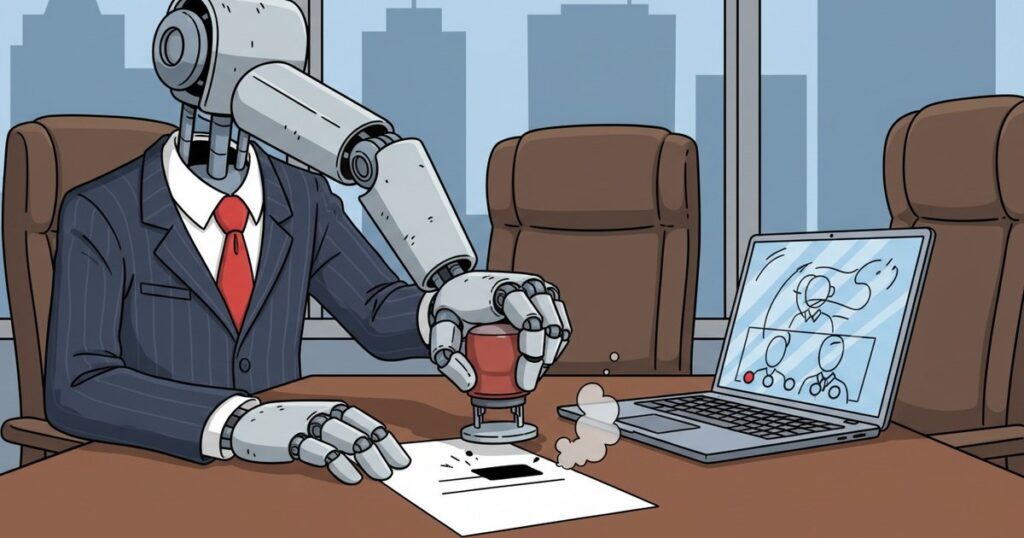
And the regulatory compliance piece — the actual sign-off that the financial data flows satisfy the auditor — has a signature requirement. Literally. Someone with a job title and legal accountability puts their name on it. The AI can prepare every artifact. A human still has to own the risk. The org chart is, in part, a liability structure.
What survives
The role does not vanish. It shrinks into something narrower and less romantic. The Head of Engineering becomes a review-and-approve function: the AI proposes architectures, the human checks them. The AI filters requirements, the human handles the escalations where the stakeholder has political capital. The AI triages pipeline failures, the human owns the ones that touch compliance boundaries. Two teams become one.
The job posting asks for a leader who "questions the status quo." The status quo is that this job needs a full-time human. Question that.
If you are the VP reading this: you are hiring a manager for two teams that could be one team that could be three engineers and an agent. The architecture decisions your new Head of Engineering will make over the next year are predictable from your current system landscape — an LLM can list them right now. The requirements they will filter are sitting in your backlog — an LLM can triage them this afternoon. What you actually need is someone to sign things and sit in meetings. Say so. Hire for that. Pay for that. Stop calling it Head of Engineering.
And if you are the candidate applying for this role: ask yourself which part of the job you are really being hired for — the engineering, or the trust. If it is the engineering, the AI is already drafting your architecture decisions. If it is the trust, fine, but then the job title is lying to you, and so is the salary band.