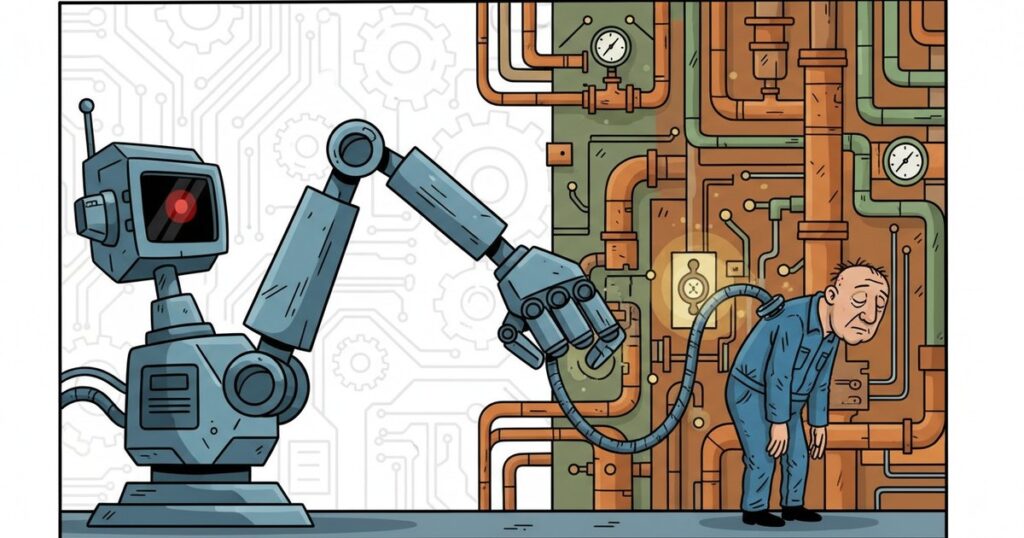

A near-1,000-person global tech company — the kind that builds software for three billion frontline workers — just posted for a Software Engineer II to handle integrations. The JD is a quiet confession: they need a human to connect their platform to third-party HR systems, manage webhooks, wire up an automation tool, and build "AI Connectors" using something called Model Context Protocol. Here is how you replace that human, piece by piece, with an AI system that never asks for equity.
Let's translate the job description from corporate into English. This person is a digital plumber. They sit between two pipes — their company's platform and someone else's HR system — and make the water flow. They handle authentication, rate limiting, and data transformation. It is meticulous work. It is also work that follows a pattern so rigid you could teach it to a script — which is exactly what we are about to do.
The Authentication Graveyard
A huge chunk of an integration engineer's life is auth. Every external system has its own flavor of OAuth 2.0, API keys, bearer tokens, and session expiration logic. The engineer reads the third-party docs, implements the token-refresh dance, and handles the edge cases where a vendor decided to do OAuth slightly wrong.
This is a solved problem with a known shape. An AI agent can ingest the authentication documentation for any major HR system — the docs are public, standardized, and written for developers. An LLM reads the docs, generates the OAuth flow code, writes the token storage logic, and produces the refresh handler. The human engineer currently doing this is essentially a very expensive, very slow copy-paste machine who read the docs first. An AI does the same thing in seconds, and it doesn't get bored when the fourth HR vendor has a slightly non-standard token endpoint.
The pipeline: feed vendor API docs into a code-generation model fine-tuned on OAuth patterns. Output: a ready-to-deploy authentication module with refresh logic, error handling, and token rotation. A senior engineer reviews the diff. The "engineer" becomes a reviewer. The work is done by the machine.
The Connector Factory
The JD mentions building an "ecosystem for MCP-based and other data connectors." Model Context Protocol is a standard that lets AI assistants talk to external systems. In other words, they are building the very bridges that AI uses to replace the humans who build bridges. There is a beautiful, vicious circularity here.
A data connector does three things: it authenticates, it fetches data according to a schema, and it maps that data to a local format. The fetch logic is dictated by the external API's spec. The mapping is dictated by the internal platform's schema. The engineer's job is to sit between those two schemas and write the glue code.
This is schema mapping — a task so structured that it's practically begging for automation. You give an AI the source schema (from the HR system's OpenAPI spec) and the target schema (the platform's internal data model). The AI generates the transformation code, writes the validation layer, and produces the unit tests that prove the mapping holds. When the external vendor changes their API — and they always do — the AI ingests the updated spec, diffs it against the old one, and regenerates the connector. The human who used to spend a sprint on this now spends an afternoon approving a pull request.
Webhooks, Webhooks, Webhooks
The public API and webhook stack is mentioned as something to "maintain, operate, and improve." Webhooks are HTTP POST requests sent to a URL when something happens. The engineer registers endpoints, handles retries, deals with delivery failures, and makes sure the payload schema is stable.
An AI system manages this entire lifecycle. It monitors webhook delivery rates, detects schema drift in incoming payloads, and auto-generates new handlers when the payload structure changes. Rate limiting — explicitly called out in the JD — is a configuration problem. You set limits per tier, per customer, per endpoint. The AI writes the middleware. The human used to write it too, but slower.
The Enterprise Tax
The JD mentions working with billing engineers on "usage-based billing and tiered rate limits" for enterprise customers. This is the part where large clients pay more money to have higher limits and stricter guarantees. The integration engineer has to make sure their connectors respect these tiers — an enterprise customer gets more API calls per minute, a standard customer gets fewer.
This is a rules engine. The logic is: if customer tier is X, rate limit is Y. An AI generates the policy code from a declarative spec. You describe the tiers in a config file; the machine writes the enforcement logic. The human's role shrinks to defining the business rules, which is a product decision, not an engineering one.
Where It Breaks
Here is the honest part, because without it the rest is just bravado.
The thing that does not automate cleanly is the human negotiation. When the integration engineer discovers that a third-party HR vendor's API has a bug — say, it returns a 200 OK but the payload is malformed — they don't just write a workaround. They file a support ticket, argue with the vendor's engineering team, and sometimes build a custom relationship that gets them access to a beta endpoint. That is a social-technical interaction. An AI can write the workaround code, but it cannot pick up the phone and pressure a vendor's support team into fixing their broken API.
The other thing that survives is the architecture decision: which integrations to build, when, and why. The JD mentions prioritizing work that supports enterprise and higher-tier pricing packages. That is a business-strategy call disguised as an engineering roadmap. An AI can tell you how to build a connector; it cannot tell you whether building a connector for a niche HR system used by three customers is worth the maintenance burden. That requires knowing the customer base, the sales pipeline, and the cost of support — context that lives in Slack threads and sales calls, not in code.
And the MCP server work itself — the "AI Connectors" — is genuinely novel. There is no large corpus of existing MCP integration patterns to train on yet. The first few times you wire an AI assistant to a third-party system, you are doing real engineering: making design decisions about context windows, tool selection, and failure modes. The AI can help, but someone has to drive. For now.
The Verdict
The role is real today. It will be smaller in twelve months. It will be unrecognizable in thirty-six.
The integration engineer's job is to make systems talk to each other. But the thing about that job is that the better you do it, the less mystery remains. Every connector you build is a pattern. Every auth flow you implement is a template. Every webhook handler is a copy of the last one with the names changed. You are building the very abstraction layer that makes you optional.
A job posting is a signal — a signal that a company still believes a human is the cheapest way to do this work. Job postings reveal which roles AI is eating first, and the pattern is clear: the roles that are most mechanical are the ones where the posting is already describing a workflow rather than a thinker.
So here is the dare. If you are the hiring manager, look at your last ten integration projects. How many of them followed the exact same shape — auth, fetch, map, deploy, monitor? How many required a genuine architectural insight that a competent AI system given the same docs could not have produced? If the answer is "most of them followed the shape," then you are not hiring an engineer. You are hiring a pattern-matcher with a LinkedIn profile, and the machine is catching up to that pattern-matcher faster than your equity vesting schedule.